Category: Contract Clauses

  • What Is Contract Redlining? How Lawyers Mark Up Agreements

    What Is Contract Redlining? How Lawyers Mark Up Agreements

    What Is Contract Redlining? How Lawyers Mark Up Agreements

    The average commercial contract goes through 3.4 rounds of negotiation before execution. Each round involves at least two lawyers marking up the same document, tracking who changed what, and trying not to lose revisions in an email chain that has grown to 47 messages. According to the World Commerce & Contracting 2025 Benchmark Report, organizations experience an average of 8.6% value erosion in their contracting processes — and much of that waste happens during the redlining phase.

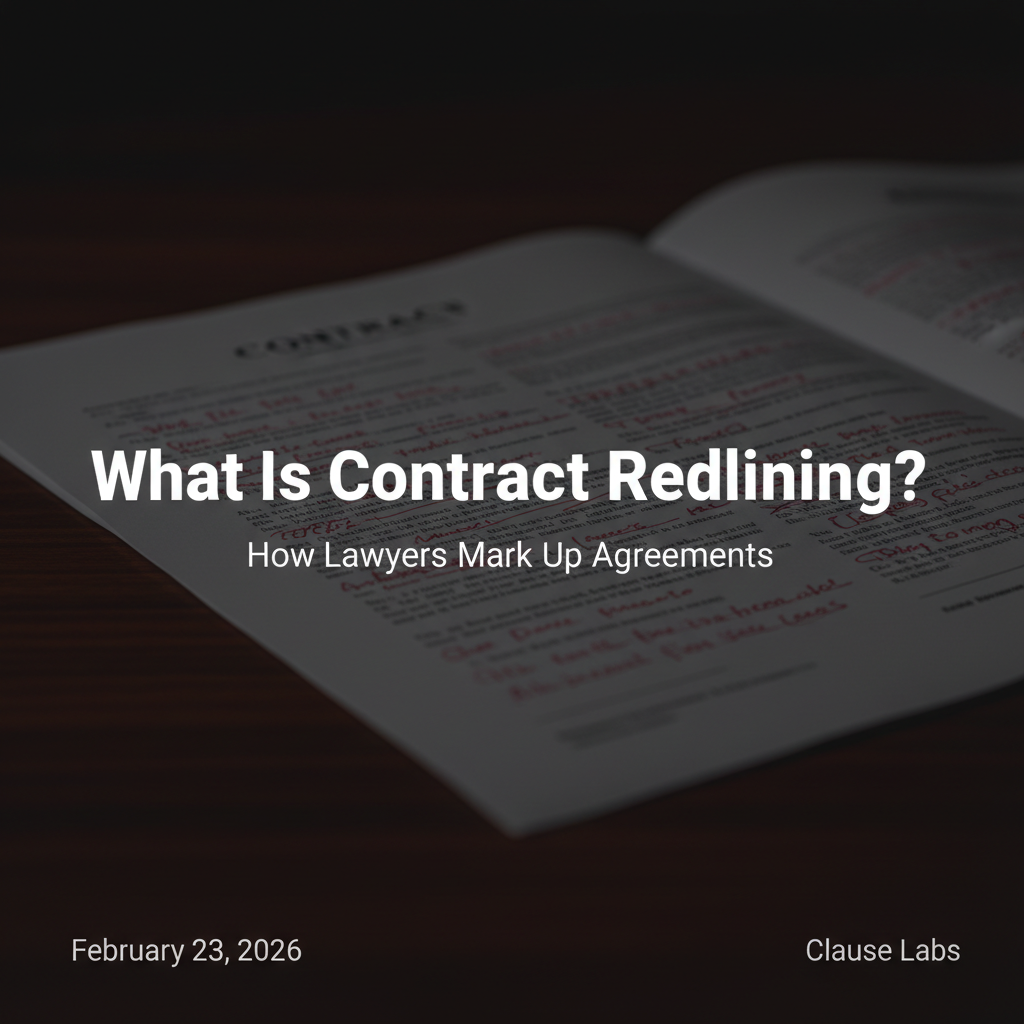
    Redlining is the process of marking proposed changes to a contract so that all parties can see exactly what has been added, deleted, or modified. It’s the mechanism by which lawyers negotiate. And despite being the single most time-consuming activity in contract work, most lawyers learn it by trial and error rather than formal training.

    This guide covers what contract redlining is, where the term comes from, how the process works in practice, the tools lawyers use, and the etiquette and best practices that separate clean negotiations from chaotic ones. If you want to see how AI handles the redlining process, try Clause Labs’s free contract analyzer — it generates suggested redlines with tracked changes and plain-English explanations in under 60 seconds.

    Where the Term “Redlining” Comes From

    The term is literal. Before word processors existed, lawyers reviewed contracts on paper and used red pens to mark changes. Red ink stood out against the black printed text, making edits immediately visible. Additions were written in the margins. Deletions got a red line drawn through them — hence “redlining.”

    According to the ABA’s article on track changes and redlining, this manual process worked for short agreements but became impractical as contracts grew longer and more complex. A 50-page MSA with changes from three parties produced a document so marked up that it was nearly unreadable.

    The shift to digital happened in stages:

    • 1980s-1990s: Word processors introduced basic revision tracking
    • 1995-2000s: Microsoft Word’s Track Changes feature became the de facto standard for legal markup
    • 2010s: Cloud-based collaboration tools (Google Docs, SharePoint) added real-time co-editing
    • 2020s: AI-powered tools began generating suggested redlines automatically, analyzing contracts and proposing specific changes based on risk analysis and legal playbooks

    Today, “redlining” refers to the entire process of proposing, reviewing, and negotiating contract changes — regardless of whether anyone picks up a red pen.

    How Contract Redlining Works in Practice

    The Basic Workflow

    1. Party A drafts the initial contract (the “first draft” or “send-out draft”). This version favors Party A’s interests.

    2. Party B’s lawyer reviews the draft and marks up proposed changes using Track Changes in Microsoft Word. Additions appear in colored text. Deletions appear as strikethrough text. Comments explain the reasoning behind significant changes.

    3. Party B returns the redlined draft to Party A.

    4. Party A reviews Party B’s redlines, accepts some changes, rejects others, and proposes counter-edits. This produces a new redlined version.

    5. The cycle repeats until both parties agree on final language. The agreed version is “turned clean” (all changes accepted, Track Changes turned off) and sent for signature.

    Redlining vs. Blacklining

    These terms are often confused:

    • Redlining is the active process of marking changes in a document. The lawyer edits the contract with Track Changes on, adding and deleting language.
    • Blacklining (or “legal blacklining”) is a comparison function. Microsoft Word’s Compare Documents feature produces a blackline — a new document showing every difference between two versions. As LexCheck’s comparison of the two concepts explains, blacklining is useful when you receive a “clean” revised draft without tracked changes and need to see what the other side actually changed.

    Why this matters in practice: If opposing counsel sends you a “clean” revised version without Track Changes, always run a blackline comparison against the previous version. Changes made without Track Changes — whether intentional or accidental — are a common source of contract disputes.

    Tools Lawyers Use for Redlining

    Microsoft Word Track Changes

    Still the dominant tool for legal redlining. Word’s Track Changes feature records every insertion, deletion, and formatting change, showing who made each edit and when.

    Key features for legal work:
    Simple Markup vs. All Markup display modes
    Accept/Reject individual changes or all changes at once
    Compare Documents (for generating blacklines)
    Combine Documents (for merging edits from multiple reviewers)
    Restrict Editing to prevent unauthorized changes to certain sections
    Mark as Final to indicate the document is ready for signature

    According to the ABA’s 2024 Legal Technology Survey, Microsoft Word remains the word processor used by over 95% of law firms for contract drafting and negotiation.

    Common pitfalls:
    – Metadata leaks: Word files can contain hidden Track Changes history, comments, and author information. Always run the Document Inspector before sending externally.
    – Version confusion: Emailing redlined documents back and forth creates version control problems. Name files systematically (e.g., “MSA_ClientCo_Redline_v3_2026-02-15.docx”).
    – Hidden changes: If Track Changes was turned off during editing, those changes won’t appear in the markup. Always verify with a blackline.

    Google Docs Suggesting Mode

    Google Docs’ “Suggesting” mode functions similarly to Word’s Track Changes. Suggested edits appear as colored insertions and deletions that can be accepted or rejected individually.

    Advantages: Real-time collaboration, automatic version history, no email attachments.
    Limitations: Less common in legal practice, limited formatting control, fewer firms accept Google Docs for contract negotiation. Most opposing counsel expect a Word document.

    Contract Lifecycle Management (CLM) Platforms

    Enterprise tools like Ironclad, DocuSign CLM, and Icertis provide built-in redlining within broader contract management workflows. These platforms offer version control, approval routing, and audit trails — but they’re designed for in-house legal teams managing high volumes, not for solo practitioners negotiating individual deals.

    AI-Powered Redlining Tools

    The newest category. AI redlining tools analyze a contract, identify provisions that deviate from a standard playbook, and suggest specific edits automatically. The lawyer then reviews, accepts, or modifies the AI’s suggestions.

    The Thomson Reuters 2025 report on AI in professional services found that 26% of legal organizations were actively using generative AI in 2025, with document review and contract analysis among the top applications. By 2026, that number has continued to rise.

    Clause Labs generates AI redlines as part of its contract review pipeline — uploading a contract produces not just a risk analysis but specific suggested edits displayed as tracked changes. Lawyers can accept or reject each suggestion individually, then export the result as a Word document with proper tracked changes formatting. Upload any contract to see AI-generated redlines — the Solo plan ($49/month, 25 reviews) includes DOCX export with proper tracked changes, ready to send to opposing counsel.

    For a deeper look at how AI redlining compares across different tools, see our comparison of the best AI contract review tools.

    Redlining Etiquette: The Unwritten Rules

    Every experienced lawyer knows these rules, but they’re rarely taught formally. Violating them signals inexperience and can damage the negotiating relationship.

    1. Always Use Track Changes

    Never send a revised contract without tracked changes unless you explicitly tell the other side you’re sending a clean version. Sending a “clean” document with hidden changes is considered a breach of professional courtesy — and in some jurisdictions, it could raise ethical concerns under ABA Model Rule 8.4 (misconduct) if done intentionally to deceive.

    2. Don’t Redline Every Word

    Changing “shall” to “will” throughout a 40-page agreement sends a message: you’re more interested in imposing your style than negotiating substance. Focus your redlines on provisions that change the parties’ rights, obligations, or risk allocation. Leave stylistic preferences aside unless they create legal ambiguity.

    3. Explain Significant Changes in Comments

    For any redline that materially changes a party’s obligations, add a comment explaining your reasoning. “Deleted because one-sided” is more productive than a deletion with no explanation. Comments reduce the number of negotiation rounds by helping opposing counsel understand your position without a phone call.

    4. Don’t Reject and Re-Insert

    Rejecting the other side’s language and then re-inserting identical or nearly identical language (often in a different color) is confusing and counterproductive. If you’re rejecting a proposed change, leave it rejected. If you want to modify it, accept their change first, then make your counter-edit with a new tracked change.

    5. Turn Your Redline Before Sending

    After marking up the document, review your own changes. Are they consistent? Do your edits in Section 3 conflict with language you left unchanged in Section 8? Does the defined term you changed on page 2 still work on page 15? A sloppy redline undermines your credibility.

    6. Number Your Drafts

    Use a clear naming convention. Something like:
    MSA_CompanyA_CompanyB_Draft1.docx (initial send)
    MSA_CompanyA_CompanyB_Draft2_CompanyB_Redline.docx (counterparty’s markup)
    MSA_CompanyA_CompanyB_Draft3_CompanyA_Response.docx (your response)

    This prevents the “which version are we on?” problem that derails negotiations.

    Common Redlining Mistakes

    1. Editing with Track Changes Off

    It happens more often than anyone admits. The lawyer edits the document, forgets to turn on Track Changes, and sends a “clean” version that contains hidden modifications. The other side runs a blackline, discovers the changes, and trust evaporates.

    Prevention: Set Word to always track changes when opening certain document types, or use the “Lock Tracking” feature that requires a password to turn off Track Changes.

    2. Failing to Run a Blackline on Incoming “Clean” Drafts

    If opposing counsel sends a clean version, you must compare it against the last version you sent. Our guide to reviewing contracts for red flags covers this as a critical step in every review process.

    3. Metadata Exposure

    Track Changes history can reveal internal strategy — deleted comments from your partner, draft language you considered and rejected, author names that show who at your firm worked on the document. Always strip metadata before sending a redlined document externally.

    How to strip metadata in Word:
    File > Info > Check for Issues > Inspect Document > Document Inspector > Remove All

    4. Losing Track of Versions

    With multiple rounds of redlines flying between parties, it’s easy to respond to an outdated version. This creates conflicting edits that take hours to untangle.

    Solution: Maintain a version log. Note the date each version was sent and received, by whom, and the key changes in that round.

    5. Over-Redlining as a Negotiation Tactic

    Some lawyers mark up every provision in a contract as a power move. This backfires. It tells the other side you’re either unreasonable or didn’t read the document carefully enough to identify what actually matters. Focused, substantive redlines carry more weight.

    Redlining in the Age of AI

    AI is changing how lawyers approach redlining in three specific ways:

    1. Automated first-pass redlining. AI tools analyze a contract against a defined playbook (set of rules about acceptable and unacceptable provisions) and generate initial markup. The lawyer reviews the AI’s suggestions rather than reading every clause from scratch. This is what Clause Labs does — the AI generates suggested edits with tracked changes, and you accept or reject each one.

    2. Consistency checking. AI can verify that your redlines are internally consistent — that a defined term changed in Section 1 is updated throughout the document, that a liability cap change in Section 7 doesn’t conflict with the indemnification carve-out in Section 9.

    3. Risk-based prioritization. Instead of reading a 50-page contract linearly, AI identifies the highest-risk provisions first. Gartner predicts that AI and contract analytics are urgent priorities for general counsel, with organizations using AI in contract management cutting review time by up to 50%.

    What AI doesn’t replace: the strategic decisions about what to push for, what to concede, and how to frame your position. Redlining is negotiation in written form. AI handles the pattern matching and error checking. The lawyer handles the judgment.

    For a detailed comparison of AI contract review tools that include redlining capabilities, see our comprehensive guide to AI contract review tools.

    Frequently Asked Questions

    Is redlining the same as editing a contract?

    Not exactly. Redlining specifically refers to making visible, trackable changes during contract negotiation — so all parties can see what was changed and by whom. Editing is a broader term that includes internal revisions not shared with the other side.

    How many rounds of redlining is normal?

    For a standard commercial contract (NDA, simple services agreement), 1-2 rounds. For complex agreements (MSAs, M&A documents, technology licenses), 3-5 rounds is typical. Anything beyond 6-7 rounds usually signals a fundamental disagreement on deal terms that should be resolved in a phone call, not through more markup.

    Should I redline or call?

    Both. Redlining documents the specific language changes. Phone calls (or video calls) resolve disagreements about business terms and priorities faster than exchanging marked-up drafts. The most efficient negotiators use calls to reach agreement on principles, then redlines to capture the agreed language.

    Can AI replace manual redlining?

    AI can generate a strong first draft of redlines based on your playbook preferences, but it cannot replace the lawyer’s judgment about what changes to propose in a specific deal context. The technology is a force multiplier, not a substitute. The ABA’s Formal Opinion 512 on generative AI makes clear that lawyers remain responsible for supervising AI-generated work product.

    What format should I send redlined documents in?

    Microsoft Word (.docx) with Track Changes is the universal standard in legal practice. Never send a redlined document as a PDF unless you’re specifically asked to — PDFs strip the ability to accept or reject individual changes. If you use Google Docs internally, export to Word before sending to opposing counsel.


    This article is for informational purposes only and does not constitute legal advice. Consult a qualified attorney for advice specific to your situation.

    Want to see AI-generated redlines on your next contract? Upload any agreement to Clause Labs and get suggested edits with tracked changes in under 60 seconds. Export as a Word document with proper markup — ready to send to opposing counsel. Start free with 3 reviews per month.
  • What Is a Master Service Agreement (MSA)? A Plain-English Guide

    What Is a Master Service Agreement (MSA)? A Plain-English Guide

    What Is a Master Service Agreement (MSA)? A Plain-English Guide

    A technology company signs a three-year deal with a consulting firm. Six months in, the consultant takes on a second project. Then a third. Each time, both legal teams spend three weeks negotiating payment terms, liability caps, and confidentiality obligations they already agreed to in the first contract. By the time the fourth project launches, the client has spent more on legal fees for redundant negotiations than the project itself costs.

    That’s the problem a master service agreement solves. An MSA establishes the foundational legal terms between two parties once, so every future project launches with a short statement of work instead of a full contract negotiation. According to Axiom Law’s guide to MSAs, organizations that use MSAs reduce contract cycle times by 50-80% for subsequent engagements under the same framework.

    If your practice involves repeat business relationships — consulting, IT services, professional services, outsourcing, marketing, or any industry where one party regularly provides services to another — MSAs are a contract type you need to master. This guide explains what they are, how they work, what they include, and where negotiations typically break down. If you’re reviewing an MSA right now, Clause Labs’s free analyzer can score its risk profile and flag problematic provisions in under 60 seconds.

    The MSA-SOW Relationship: How It Actually Works

    The defining feature of a master service agreement is its relationship with statements of work (SOWs). Understanding this hierarchy is essential.

    The MSA is the parent contract. It establishes the general legal terms that govern the entire business relationship: how disputes are resolved, who owns intellectual property, what happens if someone breaches the agreement, confidentiality obligations, liability caps, insurance requirements, and termination rights.

    The SOW is the child document. It describes a specific project or engagement: what work will be done, by whom, on what timeline, for what price, and with what deliverables. According to Ironclad’s comparison of MSAs and SOWs, a single MSA may have dozens or even hundreds of SOWs executed under it over the life of the relationship.

    Think of it as a franchise model for contracts. The MSA is the franchise agreement — it sets the rules. Each SOW is a new store opening — it describes the specific location, staffing, and budget, but operates under the same rules as every other location.

    What Goes in the MSA vs. the SOW

    MSA (Negotiated Once) SOW (Negotiated Per Project)
    Payment terms and invoicing procedures Project-specific pricing and budget
    Intellectual property ownership Specific deliverables and acceptance criteria
    Confidentiality obligations Timeline and milestones
    Limitation of liability and indemnification Staffing and personnel requirements
    Insurance requirements Project-specific technical specifications
    Termination and dispute resolution Change order process for that project
    Governing law and jurisdiction Completion criteria and sign-off process
    Representations and warranties Expenses and travel for that engagement

    Conflict Resolution Between MSA and SOW

    Here’s a critical drafting point many practitioners miss: what happens when the MSA and SOW contradict each other?

    Most MSAs include an “order of precedence” clause stating that the MSA governs in case of conflict. But some deals flip this — the SOW takes precedence. This matters enormously when a SOW includes a one-off liability cap that differs from the MSA’s standard cap, or when project-specific IP terms override the general IP assignment clause.

    Best practice: Always include an explicit order of precedence clause. And when drafting SOWs, flag any provision that deviates from the MSA’s standard terms.

    Key Provisions in a Master Service Agreement

    1. Scope of Services

    The MSA defines the general categories of services the provider will deliver. This doesn’t need to be as specific as the SOW — it establishes the boundaries of the relationship. A technology MSA might cover “software development, systems integration, and related consulting services.” Individual SOWs then specify exactly what project falls within that scope.

    2. Payment Terms

    Standard payment provisions include:

    • Invoicing frequency (monthly, upon milestone completion, or upon delivery)
    • Payment window (Net 30 and Net 45 are most common)
    • Late payment penalties (1-1.5% per month is standard)
    • Expense reimbursement rules and approval thresholds
    • Rate adjustment provisions for multi-year MSAs (often tied to CPI or capped at 3-5% annually)

    According to Clio’s 2025 Legal Trends Report, payment terms are among the top five most-negotiated provisions in service contracts. The most common dispute: whether travel time is billable.

    3. Intellectual Property Ownership

    This is frequently the most contentious provision in any MSA. The core question: who owns what the provider creates?

    Three common structures:

    • Client owns everything. All work product, deliverables, and IP created during the engagement belong to the client. Providers resist this because it can include improvements to their pre-existing tools and methodologies.
    • Provider retains IP, client gets a license. The provider keeps ownership of underlying tools, frameworks, and methodologies. The client receives a perpetual, non-exclusive license to use the deliverables. Common in software development MSAs.
    • Split ownership. The client owns project-specific deliverables. The provider retains ownership of pre-existing IP and general methodologies. This requires careful definition of “pre-existing IP” and “project-specific deliverables.”

    For a deeper analysis of IP provisions in contracts, see our guide to intellectual property clauses.

    4. Confidentiality

    Most MSAs include built-in confidentiality provisions rather than requiring a separate NDA. These provisions should mirror the structure of a well-drafted NDA: defined scope of confidential information, standard exclusions, permitted use, duration, and return/destruction obligations.

    Key consideration: If the parties already have a standalone NDA, the MSA should reference and incorporate it, or supersede it entirely. Having both in effect with inconsistent terms creates ambiguity.

    5. Indemnification

    Indemnification provisions allocate risk for third-party claims. In an MSA context, the typical structure includes:

    • Provider indemnifies client for IP infringement claims, bodily injury caused by the provider’s personnel, and breaches of confidentiality
    • Client indemnifies provider for claims arising from the client’s materials, instructions, or specifications that the provider relied on
    • Mutual indemnification for breaches of representations and warranties

    As Gouchev Law’s analysis of MSA risk allocation explains, the indemnification provisions and the limitation of liability clause work together. Indemnification obligations are often carved out of the general liability cap — meaning a $500,000 liability cap may not apply to IP infringement indemnification.

    For more on how indemnification and limitation of liability interact, see our analysis of limitation of liability clauses.

    6. Limitation of Liability

    This clause caps the maximum amount one party can recover from the other for breach. Standard MSA structures include:

    • General liability cap: Typically set at 12 months of fees paid under the MSA (or a specific dollar amount)
    • Consequential damages waiver: Both parties waive recovery of indirect, incidental, and consequential damages
    • Carve-outs: Certain obligations — usually IP indemnification, confidentiality breaches, and willful misconduct — are carved out of the cap, subject either to no cap or to a higher “super cap” (often 2-3x the general cap)

    According to the World Commerce & Contracting 2025 Benchmark Report, limitation of liability is the single most negotiated provision in commercial contracts, with organizations reporting an average of 8.6% value erosion during contract management processes — much of which stems from poorly negotiated risk allocation.

    7. Term and Termination

    MSAs typically include:

    • Initial term (1-3 years is standard for most commercial MSAs)
    • Auto-renewal provision (often for successive 1-year terms unless either party provides 30-90 days’ notice)
    • Termination for cause (material breach with a cure period, typically 30 days)
    • Termination for convenience (either party can walk away with 30-90 days’ notice)
    • Effect on active SOWs — what happens to projects in progress when the MSA terminates

    Critical question: Does terminating the MSA automatically terminate all active SOWs? Or do active SOWs survive until completion? This varies by agreement, and getting it wrong can leave either party stranded mid-project.

    8. Representations and Warranties

    Standard MSA representations include:

    • Authority to enter the agreement
    • No conflicts with other obligations
    • Compliance with applicable laws
    • Provider has the skills and resources to perform the services
    • Services will be performed in a professional and workmanlike manner

    The “workmanlike manner” warranty is deceptively important. It establishes the minimum quality standard for the provider’s work and gives the client a contractual basis for objecting to substandard deliverables.

    9. Insurance Requirements

    Most MSAs require the service provider to maintain minimum insurance coverage:

    • Commercial general liability (typically $1-2 million per occurrence)
    • Professional liability / errors & omissions (typically $1-5 million)
    • Workers’ compensation (as required by state law)
    • Cyber liability (increasingly standard, especially for technology MSAs)

    The client is usually named as an additional insured on the provider’s commercial general liability policy.

    10. Dispute Resolution

    Three common approaches:

    • Escalation clause: Disputes first go to designated executives for negotiation (30 days), then to mediation, then to arbitration or litigation
    • Mandatory arbitration: Binding arbitration under AAA or JAMS rules, which is faster but may limit discovery and appellate rights
    • Litigation with venue selection: Suit filed in a specified court, which may favor one party depending on the chosen jurisdiction

    When to Use an MSA

    An MSA makes financial and operational sense when:

    • You expect multiple engagements with the same counterparty over 12+ months
    • Your deal involves complex legal terms that would be expensive to negotiate repeatedly
    • Both parties want speed-to-start for new projects under an existing relationship
    • The relationship involves significant risk (high-value services, sensitive data, IP creation) that warrants thorough risk allocation upfront

    An MSA may not be necessary when:

    • You’re engaging a provider for a single, well-defined project
    • The total contract value is small enough that a simple services agreement suffices
    • The parties are unlikely to work together again after the current engagement

    Key Negotiation Points: Where MSA Deals Get Stuck

    Based on common patterns in MSA negotiations, these five provisions generate the most back-and-forth:

    1. Liability cap amount. Providers want it as low as possible (often 1x annual fees). Clients push for higher caps or unlimited liability for certain breach types. The ABA’s Model Rules require lawyers to competently advise clients on risk allocation — which means understanding what liability cap is reasonable for the deal.

    2. IP ownership. Clients want to own all work product. Providers want to retain their tools and methodologies. The compromise usually involves client ownership of project-specific deliverables with provider retention of pre-existing IP and a license back for any improvements.

    3. Termination for convenience. Providers resist this because it means the client can walk away from a multi-year commitment without cause. Clients insist on it for flexibility. The compromise often involves a termination fee (payment for work in progress plus a percentage of remaining contract value).

    4. Indemnification scope. Clients want broad indemnification covering all provider breaches. Providers want to limit indemnification to third-party IP claims and bodily injury. The Thomson Reuters 2025 AI in Professional Services Report noted that contract negotiation, particularly around risk allocation, remains one of the areas where AI adoption is growing fastest.

    5. Data rights and security. In technology MSAs, who owns the data? Who is responsible for data breaches? What happens to client data upon termination? These provisions have become significantly more complex and more heavily negotiated since GDPR and state privacy laws reshaped the compliance landscape.

    How AI Assists with MSA Review

    MSAs are among the most complex commercial contracts, averaging 20-40 pages with dense legal provisions. Manual review of a single MSA typically takes 2-4 hours. AI contract review tools can reduce that first-pass review time significantly.

    According to the ABA’s 2024 Legal Technology Survey, document review is the top AI use case among attorneys, and MSAs are particularly well-suited for AI analysis because they follow standardized structures with well-defined provision types.

    What AI catches in MSAs:

    • Missing standard provisions (no liability cap, no termination for convenience, no insurance requirements)
    • One-sided indemnification obligations
    • Liability caps that don’t include appropriate carve-outs
    • Auto-renewal provisions without adequate notice periods
    • IP ownership clauses that capture the provider’s pre-existing tools
    • Termination provisions that leave active SOWs in limbo

    Clause Labs’s MSA playbook analyzes all key provisions and provides a risk score with specific recommendations. The $49/month Solo plan includes 25 reviews — enough for most solo practitioners handling regular MSA work.

    Frequently Asked Questions

    What’s the difference between an MSA and a regular service contract?

    A regular service contract covers a single engagement. An MSA establishes terms for an ongoing relationship, with individual engagements defined in separate SOWs. The MSA saves time and legal fees when the parties expect to work together on multiple projects.

    Are MSAs legally binding?

    Yes. An MSA is a fully enforceable contract. However, most MSAs don’t create an obligation to purchase services — they establish terms that apply when services are ordered via a SOW. The SOW, combined with the MSA, creates the binding obligation to perform and pay.

    How long should an MSA last?

    Initial terms of 1-3 years are standard, with auto-renewal for additional 1-year terms. Multi-year MSAs should include rate adjustment provisions and periodic review mechanisms. The key is matching the MSA term to the expected duration of the business relationship.

    Can I use an MSA template?

    Templates are a reasonable starting point for standard commercial engagements. However, MSAs involve complex risk allocation that should be tailored to the specific relationship. Our free MSA template provides a solid foundation, but review it for deal-specific risks before signing.

    What’s the biggest mistake in MSA negotiations?

    Spending weeks negotiating liability caps and ignoring the order of precedence clause. If the SOW can override the MSA’s liability provisions without explicit approval, the entire MSA negotiation was wasted. Always define how MSA and SOW terms interact.

    Do MSAs need to be notarized?

    No. MSAs are standard commercial contracts that require signatures from authorized representatives of each party but do not require notarization. Electronic signatures are valid under the federal ESIGN Act and the Uniform Electronic Transactions Act adopted by 47 states.


    This article is for informational purposes only and does not constitute legal advice. Consult a qualified attorney for advice specific to your situation.

    Reviewing an MSA and want a second opinion before your billable clock starts? Upload it to Clause Labs for a free risk analysis — the AI reviews all key provisions and gives you a prioritized list of issues in under 60 seconds. Start free with 3 reviews per month, no credit card required.

  • What Is a Non-Disclosure Agreement (NDA)? Everything You Need to Know

    What Is a Non-Disclosure Agreement (NDA)? Everything You Need to Know

    What Is a Non-Disclosure Agreement (NDA)? Everything You Need to Know

    Every business deal begins with a question: how much do I share before I have a signed contract? A prospective buyer wants to see your financials. A potential partner needs access to your client list. A vendor requires your proprietary specifications. Share too much without protection, and you’ve given away your leverage. Share too little, and the deal never gets off the ground.

    That’s why NDAs exist. A non-disclosure agreement is the legal mechanism that lets two (or more) parties share sensitive information while maintaining enforceable confidentiality obligations. According to Cornell Law Institute’s legal definition, an NDA is a legally enforceable contract that creates a confidential relationship between parties, preventing signatories from disclosing information covered by the agreement.

    NDAs are the most commonly executed business contract in the United States. If you handle transactions, partnerships, employment relationships, or vendor engagements, you encounter them weekly. And yet they remain one of the most poorly drafted and least understood agreements in commercial practice. This guide covers what an NDA actually is, the different types, the clauses that matter, and what makes one enforceable or worthless. If you want to test your own NDAs for risk, Clause Labs’s free analyzer will score any NDA and flag problems in under 60 seconds.

    What an NDA Actually Does (and Doesn’t Do)

    An NDA creates a contractual duty of confidentiality between the parties. The receiving party agrees not to disclose, use, or exploit the disclosing party’s confidential information except as permitted by the agreement. If the receiving party breaches that duty, the disclosing party has a legal cause of action for breach of contract and potentially other remedies.

    What an NDA does not do:

    • It does not create trade secret protection. Trade secret status under the Uniform Trade Secrets Act and the Defend Trade Secrets Act (18 U.S.C. Section 1836) requires independent reasonable efforts to maintain secrecy. An NDA is one such effort, but it alone doesn’t establish trade secret status.
    • It does not prevent reverse engineering (unless the NDA specifically prohibits it).
    • It does not cover information that becomes public through no fault of the receiving party.
    • It does not prevent employees from reporting illegal activity. Federal whistleblower protections, including the Speak Out Act of 2022, override NDA provisions in specific contexts.

    Understanding these limits is as important as understanding the protections. An NDA that tries to do too much is often unenforceable. One drafted with precision typically holds up in court.

    Types of Non-Disclosure Agreements

    Unilateral (One-Way) NDA

    One party discloses confidential information; the other receives it and agrees not to share it. This is the most common type in employment, vendor, and investor contexts.

    Typical use cases:
    – Employer sharing proprietary processes with a new hire
    – Company sharing financials with a potential acquirer during due diligence
    – Startup pitching to an investor and sharing product details

    Mutual (Bilateral) NDA

    Both parties share confidential information with each other and both assume confidentiality obligations. This is standard in partnerships, joint ventures, and business negotiations where both sides bring proprietary value to the table.

    Typical use cases:
    – Two companies exploring a strategic partnership
    – Merger discussions where both sides share financials
    – Technology licensing negotiations

    For a deeper look at mutual NDA drafting, see our free mutual NDA template and the common NDA mistakes analysis.

    Multi-Party NDA

    Three or more parties share confidential information under a single agreement. Less common, but used in consortium deals, multi-party joint ventures, and complex transactions.

    Key drafting challenge: Defining who can share what with whom. Multi-party NDAs often need a matrix of permitted disclosures, which adds complexity.

    The 8 Clauses That Make or Break an NDA

    Not all NDA clauses are created equal. These eight determine whether your agreement actually protects anything.

    1. Definition of Confidential Information

    This is the most important clause in any NDA. Too broad, and courts may refuse to enforce it. Too narrow, and you’ve left critical information unprotected.

    What works: A definition that identifies categories of protected information (financial data, customer lists, technical specifications, business plans) while including a catch-all for information “marked as confidential or that a reasonable person would understand to be confidential.”

    What fails: “All information shared between the parties.” Courts have repeatedly found this kind of unlimited scope unenforceable because it doesn’t put the receiving party on notice of what they actually need to protect.

    2. Exclusions from Confidential Information

    Every enforceable NDA includes standard exclusions. Five are universally recognized:

    1. Information already in the public domain (through no fault of the receiving party)
    2. Information the receiving party already possessed before disclosure
    3. Information independently developed by the receiving party
    4. Information received from a third party without restriction
    5. Information required to be disclosed by law or court order (with notice)

    Omitting these exclusions creates ambiguity and weakens enforceability. For more on what courts look for, see our guide to contract clauses that cause costly mistakes.

    3. Permitted Use / Purpose Limitation

    The NDA should specify what the receiving party can do with the information — usually limited to evaluating or performing under a specific business purpose. Without a purpose limitation, the receiving party might argue they can use the information for any reason, so long as they don’t disclose it to third parties.

    4. Duration

    Two key time periods matter:

    • Term of the agreement — How long the parties will share information (often 1-2 years, or the duration of the business relationship)
    • Survival period — How long the confidentiality obligation lasts after the agreement terminates (often 2-5 years, sometimes perpetual for trade secrets)

    A perpetual NDA is not automatically unenforceable, but courts scrutinize them more carefully. For trade secrets, perpetual duration is reasonable. For general business information, 2-3 years post-termination is the standard.

    5. Return or Destruction Obligations

    What happens to confidential information when the NDA expires or the relationship ends? The standard clause requires the receiving party to either return all confidential materials or destroy them and certify the destruction in writing.

    Practical note: With digital information, true “destruction” is nearly impossible. Good NDAs acknowledge this and require deletion from active systems, with exceptions for information retained in routine backup systems or as required by law.

    6. Remedies

    Most NDAs include a provision acknowledging that a breach would cause “irreparable harm” and that the disclosing party is entitled to injunctive relief without posting a bond. This matters because money damages alone are often inadequate for confidentiality breaches — once the information is out, you can’t un-share it.

    7. Non-Solicitation Rider

    Some NDAs include a “hidden” non-solicitation provision, preventing the receiving party from soliciting the disclosing party’s employees or customers. This is a significant additional restriction beyond confidentiality, and courts in some jurisdictions scrutinize these riders closely.

    Warning: A non-solicitation rider buried in an NDA may catch your client off guard. Always flag these provisions during review. Clause Labs’s AI specifically detects hidden non-solicitation riders during NDA analysis.

    8. Governing Law and Dispute Resolution

    Which state’s law governs the NDA? Where are disputes resolved? These provisions determine your client’s litigation costs and the legal framework for enforcement.

    When to Use an NDA (and When Not To)

    Use an NDA When:

    • Sharing financial statements, customer data, or proprietary technology during deal negotiations
    • Hiring employees or contractors who will access trade secrets
    • Engaging vendors who need access to internal systems or data
    • Discussing potential mergers, acquisitions, or investments
    • Licensing intellectual property

    Skip the NDA When:

    • The information is already publicly available
    • You’re having a general introductory conversation with no specific confidential details
    • The other party won’t sign one and the information you need to share is low-risk
    • The cost and delay of negotiating an NDA outweighs the value of the information at stake

    Use an NDA with Caution When:

    • The counterparty is in a foreign jurisdiction where enforcement is uncertain
    • The NDA would restrict activities protected by labor law or whistleblower statutes
    • You’re asked to sign a unilateral NDA that contains non-compete or non-solicitation provisions disguised as confidentiality terms

    NDA Enforceability: What Courts Actually Look For

    Not every NDA survives a legal challenge. Courts evaluating NDA enforceability typically examine these factors:

    Reasonable scope. The definition of confidential information must be specific enough that the receiving party knows what they need to protect. According to the ABA’s Model Rules on professional responsibility, lawyers have an independent duty under Rule 1.1 (Competence) to understand these enforceability requirements when drafting or reviewing NDAs for clients.

    Adequate consideration. For an NDA signed at the start of a business relationship, the relationship itself is generally sufficient consideration. For an NDA signed by an existing employee with no new benefit, consideration may be lacking in some jurisdictions.

    Reasonable duration. Courts are more likely to enforce NDAs with defined time limits. Perpetual NDAs face higher scrutiny, though they remain enforceable for information that qualifies as a trade secret under the Uniform Trade Secrets Act.

    No overreach. NDAs that effectively function as non-compete agreements — by defining “confidential information” so broadly that the receiving party can’t work in their field — may be struck down. This is especially true in states like California, which strongly disfavors restrictive covenants.

    Compliance with statutory limitations. Federal laws like the Speak Out Act limit NDA enforcement in sexual harassment and assault contexts. State laws like California’s Silenced No More Act go further. NDAs that violate these statutes are void to that extent.

    Jurisdiction Matters: State-by-State Considerations

    NDA enforceability varies by state. Here are the key differences every lawyer should know:

    California takes the narrowest view of NDAs. While confidentiality provisions are generally enforceable, any NDA provision that effectively operates as a non-compete is likely void under California Business and Professions Code Section 16600. California also restricts NDAs in employment separation agreements related to workplace harassment.

    New York generally enforces NDAs but requires consideration for agreements with existing employees. New York courts also apply a reasonableness test to scope and duration.

    Texas enforces NDAs broadly but requires them to be “ancillary to or part of an otherwise enforceable agreement” under the Texas Business and Commerce Code. A standalone NDA without a broader business relationship may face challenges.

    Florida is among the most NDA-friendly jurisdictions, but Florida Statute Section 542.335 imposes specific requirements for restrictive covenants (including non-solicitation riders in NDAs).

    Delaware is generally favorable to NDA enforcement, consistent with its business-friendly legal framework. Delaware courts regularly enforce well-drafted NDAs, particularly in the M&A context.

    Common NDA Mistakes

    Based on analysis of thousands of NDAs, these are the errors that create the most risk. For a detailed breakdown, read our analysis of common NDA mistakes.

    1. Overbroad definitions of confidential information. “All information” is practically unenforceable. Define categories.

    2. Missing standard exclusions. Without the five standard exclusions, the receiving party’s obligations become unreasonable and courts may not enforce the agreement.

    3. No defined purpose. If you don’t specify why information is being shared, you can’t limit how it’s used.

    4. Hidden non-solicitation riders. These expand the NDA far beyond confidentiality and may not be enforceable, particularly if the signer wasn’t aware of them.

    5. Perpetual duration with no trade secret carve-out. Perpetual confidentiality is reasonable for trade secrets but excessive for ordinary business information. Split the duration.

    6. No return/destruction obligation. Without this, the receiving party has no contractual duty to give back or delete your information.

    7. One-sided remedies in a mutual NDA. If both parties share information, both should have equal enforcement rights.

    8. Ignoring state-specific requirements. An NDA governed by California law operates very differently from one governed by Texas law.

    How AI Reviews NDAs: What Technology Can (and Can’t) Catch

    AI contract review tools have made NDA analysis significantly faster. According to the ABA’s 2024 Legal Technology Survey, 30.2% of attorneys now use AI-based tools in their practice, with document review among the top use cases.

    What AI does well with NDAs:

    • Identifies all key clauses and flags missing ones
    • Detects one-sided provisions in mutual agreements
    • Spots hidden non-solicitation and non-compete riders
    • Compares definitions against industry-standard language
    • Calculates whether duration and scope are within typical ranges

    What still requires human judgment:

    • Whether the definition of confidential information fits the specific business context
    • Whether the governing law choice is strategically optimal for your client
    • Whether non-standard provisions are appropriate given the deal structure
    • Whether the NDA complies with industry-specific regulations

    The best approach combines AI first-pass analysis with lawyer review. AI handles the pattern matching and completeness check; you provide the strategic judgment. Clause Labs’s NDA playbook analyzes NDAs for all eight critical clauses listed above in under 60 seconds, giving you a risk score and specific recommendations before you spend billable time on manual review.

    Frequently Asked Questions

    Do NDAs hold up in court?

    Yes, when properly drafted. Courts enforce NDAs that have a reasonable scope, adequate consideration, defined duration, and standard exclusions. Vaguely drafted NDAs with unlimited scope or perpetual duration face challenges, but a well-constructed agreement is a standard, enforceable contract.

    How long does an NDA last?

    It depends on the agreement. Common terms are 1-3 years for the information-sharing period, with a 2-5 year survival period for confidentiality obligations after termination. Trade secrets may warrant perpetual protection. The World Commerce & Contracting 2025 Benchmark Report found that contract terms — including NDA duration — are among the most frequently negotiated provisions.

    Can I break an NDA?

    Technically, anyone can breach a contract, but the consequences include lawsuits, financial damages, and potential injunctive relief. Certain NDA provisions may be unenforceable if they conflict with whistleblower protections, labor law, or statutory anti-secrecy provisions like the federal Speak Out Act.

    Do I need a lawyer to draft an NDA?

    For simple confidentiality protection between two sophisticated businesses, a well-crafted template may suffice. For complex deals, employment contexts, multi-party arrangements, or cross-jurisdictional situations, legal counsel significantly reduces the risk of an unenforceable agreement. Our free NDA template provides a solid starting point.

    What’s the difference between an NDA and a confidentiality agreement?

    None. “Non-disclosure agreement” and “confidentiality agreement” are interchangeable terms for the same legal instrument. Some practitioners prefer “confidentiality agreement” because it sounds less adversarial, but the legal effect is identical.

    What happens if someone breaks an NDA?

    The disclosing party can sue for breach of contract, seeking monetary damages (lost profits, consequential damages) and equitable relief (injunction to prevent further disclosure). Most NDAs include a provision allowing the disclosing party to seek injunctive relief without proving monetary damages, on the theory that confidentiality breaches cause irreparable harm.

    Are NDAs enforceable for former employees?

    Generally yes, but enforceability depends on whether adequate consideration was provided, whether the scope is reasonable, and whether the NDA complies with applicable state law. NDAs that effectively prevent a former employee from working in their field may be treated as non-compete agreements and subject to stricter enforceability standards.


    This article is for informational purposes only and does not constitute legal advice. Consult a qualified attorney for advice specific to your situation.

    Ready to analyze your next NDA? Upload any non-disclosure agreement to Clause Labs and get a clause-by-clause risk analysis in under 60 seconds. Free for your first three reviews each month — no credit card required.

  • Joint Venture Agreement Risks: What Your Due Diligence Should Cover

    Joint Venture Agreement Risks: What Your Due Diligence Should Cover

    Joint Venture Agreement Risks: What Your Due Diligence Should Cover

    Forty percent of joint ventures fail to meet their strategic objectives, and the majority of those failures trace back to the agreement itself — not the business plan. A poorly drafted JV agreement doesn’t just create legal exposure. It creates a governance structure where two parties with aligned goals on day one have no mechanism for resolving the misalignment that inevitably arrives on day 300.

    According to the World Commerce & Contracting, poor contract management erodes an average of 9% of annual revenue. For joint ventures — where two or more parties share capital, resources, and risk — that number is often worse. The structural complexity of a JV means more points of failure and higher stakes when something breaks.

    This article walks through the eight areas of a joint venture agreement that create the most risk. If you’re reviewing a JV agreement for a client — or drafting one from scratch — this is your due diligence roadmap. Try Clause Labs Free to run an AI risk analysis on any JV agreement in under 60 seconds.

    JV vs. Partnership vs. Strategic Alliance: Why the Structure Matters

    Before reviewing a single clause, confirm the entity structure. The legal label your client’s deal carries determines default rules, fiduciary duties, liability exposure, and tax treatment.

    A joint venture is typically formed for a specific project or limited duration. Under most state laws, JV participants are co-venturers, not general partners. As Nolo’s partnership law guide explains, a JV is related to a single transaction or defined project, while a general partnership covers a continuing business operation.

    A general partnership subjects every partner to unlimited personal liability for partnership obligations. The Revised Uniform Partnership Act (RUPA) provides default rules that apply when partners don’t address an issue in their agreement — and some of those defaults are dangerous. For example, RUPA presumes equal profit-sharing regardless of capital contributions unless the agreement says otherwise.

    A strategic alliance is a contractual arrangement without a separate legal entity. There’s no shared equity, no shared liability, and usually no shared governance. It’s the lightest-touch structure — and often the appropriate one when the collaboration is limited.

    Why it matters for due diligence: If your client thinks they’re entering a strategic alliance but the agreement creates shared capital, joint control, and profit-sharing, a court may treat the arrangement as a partnership — with all the fiduciary duties and unlimited liability that comes with it. Confirm the structure first, then review the agreement through the right legal lens.

    Risk #1: Governance and Deadlock

    Deadlock is the most common JV killer. When two 50/50 partners disagree on a material decision and the agreement has no resolution mechanism, the venture grinds to a halt.

    What to check

    • Voting thresholds. Does the agreement require unanimous consent for major decisions (capital calls, new contracts above a threshold, hiring key personnel, changes in scope)? Unanimity for everything guarantees deadlock.
    • Board composition. Who appoints board members? Can one party stack the board by appointing more representatives?
    • Reserved matters. Which decisions require supermajority or unanimous approval vs. simple majority? The list of reserved matters defines the real balance of power.
    • Deadlock resolution mechanisms. Does the agreement include an escalation process?

    The deadlock resolution hierarchy

    A well-drafted JV agreement should include a tiered approach. According to analysis by Otten Johnson, the most effective mechanisms follow this sequence:

    1. Escalation to senior management — Deadlocked decisions are referred to designated executives with authority to compromise.
    2. Mediation — A neutral third party facilitates resolution within a defined timeframe.
    3. Expert determination — For financial or technical disputes, an independent expert makes a binding decision.
    4. Shotgun clause (buy/sell) — One party names a price; the other must buy at that price or sell at that price. This creates a strong incentive for fair pricing, but it disadvantages the party with less capital.
    5. Put/call options — Pre-agreed formulas for one party to force a purchase or sale of the other’s interest.
    6. Dissolution — The ultimate resolution: wind down the venture.

    Red flag: Any JV agreement between equal partners that lacks a deadlock resolution mechanism is a ticking clock. Flag it every time. For a systematic framework to catch this and other dangerous provisions, see our complete contract red flags checklist.

    Risk #2: Capital Contributions and Funding Commitments

    The initial capital commitment is easy to negotiate. The second capital call — when the venture needs more money and one partner doesn’t want to contribute — is where the conflict erupts.

    What to check

    • Initial contribution obligations. Are they defined with specificity (amount, timing, form)?
    • Future capital call procedures. Who can trigger a capital call? What’s the approval threshold? What happens if one party can’t or won’t fund?
    • Dilution provisions. If a party fails to fund a capital call, does their ownership percentage decrease? By how much?
    • Preferred return provisions. Does the contributing party receive a preferred return on excess capital, or is the dilution the only remedy?
    • Non-cash contributions. If one party contributes IP, services, or real property instead of cash, how is that valued?

    Red flag: Agreements that reference “additional contributions as needed” without specifying the call procedure, approval threshold, or consequences of non-funding. This is a lawsuit waiting to happen. Our guide to indemnification clauses covers how related liability provisions should interact with capital contribution obligations.

    Risk #3: IP Contribution and Ownership

    Intellectual property disputes in joint ventures are expensive, slow, and often fatal to the venture. The agreement must answer three questions: What IP is each party bringing in? Who owns IP created during the venture? What happens to IP when the venture ends?

    Background IP vs. JV-Created IP

    As Norton Rose Fulbright explains in its JV IP guidance, the agreement should clearly categorize:

    • Background IP — Pre-existing IP each party contributes. This should remain owned by the contributing party, with a license granted to the JV for the venture’s purposes only.
    • Foreground IP (JV-Created IP) — New IP developed during and for the venture. Ownership options include: (a) the JV entity owns it, (b) joint ownership by both parties, or (c) one party owns it and licenses it to the other.
    • Sideground IP — IP developed by one party independently during the JV term that’s related to but not created for the venture. This is the category most agreements miss entirely.

    What to check

    • License scope. Is the Background IP license field-of-use restricted to the JV’s business? Can the JV sublicense it?
    • Ownership of Foreground IP. Is it specified? If jointly owned, who controls prosecution, licensing, and enforcement?
    • Reversion rights. When the JV ends, who keeps the Foreground IP? Does the non-retaining party get a perpetual license?
    • Employee/contractor IP. Are JV employees and contractors required to assign their inventions to the JV?

    Red flag: Agreements that state “all IP created during the JV shall be jointly owned” without addressing prosecution rights, licensing authority, or enforcement responsibilities. Under U.S. patent law, each joint owner can independently license the patent without the other’s consent — meaning one partner could license the jointly-developed technology to the other’s competitor.

    For more on how IP assignment provisions work across contract types, see our guide to IP assignment clauses.

    Risk #4: Non-Compete and Exclusivity

    JV partners often compete in adjacent markets. The non-compete provisions in the JV agreement define the boundaries — and getting them wrong creates either an unenforceable restriction or an inadvertent competitive advantage for one party.

    What to check

    • Scope during the JV. Are both parties restricted from competing with the JV in its defined market? Is the restricted territory and activity clearly defined?
    • Scope after the JV. Does the non-compete survive dissolution? For how long? With what geographic and activity limitations?
    • Carve-outs. Are each party’s existing businesses carved out? Can a party pursue opportunities the JV declines?
    • Enforceability. Non-competes in JV agreements are generally evaluated under the same state-law frameworks as employment non-competes. In states like California, which broadly voids non-compete agreements under Cal. Bus. & Prof. Code Section 16600, a JV non-compete provision may be unenforceable.

    Red flag: Non-competes that restrict a party from its core business. If your client’s existing operations overlap with the JV’s scope, the non-compete could effectively force your client out of its own market. For a deeper analysis of non-compete enforceability across jurisdictions, see our non-compete enforceability guide.

    Risk #5: Exit Mechanisms

    Every JV ends. The question is whether it ends cleanly or through litigation. The exit provisions determine the answer.

    Types of exit triggers

    • Voluntary withdrawal — Either party decides to leave. The agreement should specify notice periods, buyout procedures, and valuation methods.
    • Involuntary withdrawal — Triggered by default, breach, bankruptcy, or change of control.
    • Dissolution — The venture winds down entirely. Asset distribution, liability allocation, and IP reversion all need to be specified.

    Valuation methods

    The buyout price is the most litigated issue in JV exits. The agreement should specify:

    • Valuation methodology — Book value, fair market value, formula-based (e.g., multiple of EBITDA), or appraised value.
    • Appraiser selection — Each party selects an appraiser; if they disagree, the two appraisers select a third. The middle value (or average) controls.
    • Discounts — Whether minority or marketability discounts apply.
    • Payment terms — Lump sum, installment payments, or a combination. Installment payments create seller risk; lump sum may be impractical for the buyer.

    Red flag: Agreements that reference “fair market value as determined by mutual agreement” without a dispute resolution mechanism for valuation disagreements. When one party wants to exit, mutual agreement on price is rare.

    Risk #6: Fiduciary Duties and Conflicts of Interest

    JV co-venturers owe each other fiduciary duties, but the scope of those duties varies by state and by how the JV is structured. As Berliner Cohen LLP explains, the fiduciary duties of a JV member are often “finite and tailored to the business and activities of the venture” — narrower than the broad fiduciary duties owed by general partners.

    What to check

    • Duty modification. Does the agreement limit or modify fiduciary duties? Many state LLC statutes (used to form JV entities) permit this.
    • Related-party transactions. Does the agreement require disclosure and approval of transactions between the JV and one of the venturers?
    • Opportunity allocation. How are new business opportunities allocated? Does the JV have a right of first refusal on opportunities within its scope?
    • Information rights. Does each party have access to the JV’s books, records, and financial statements?

    Red flag: No related-party transaction disclosure requirement. Without it, one party can funnel JV business to its own affiliates at non-arm’s-length prices.

    Clause Labs’s AI analysis identifies missing conflict-of-interest provisions and one-sided governance terms across all JV agreement types. Solo practitioners reviewing complex JV agreements can use the AI-generated risk report as a first-pass before deep-diving into the provisions that matter most.

    Risk #7: Regulatory Approvals

    JV formation may trigger regulatory requirements that parties overlook until they’ve already signed.

    Antitrust

    If the JV involves competitors, it may require Hart-Scott-Rodino Act pre-merger notification. For 2026, the HSR filing threshold is $133.9 million. Even below the threshold, a JV between competitors may attract antitrust scrutiny if it restricts competition in a defined market.

    Foreign investment

    If one JV partner is a foreign entity, the Committee on Foreign Investment in the United States (CFIUS) may review the transaction. This is particularly relevant for JVs involving technology, infrastructure, or data access.

    Industry-specific

    Certain industries — healthcare, telecommunications, financial services, defense — have sector-specific regulatory requirements that apply to JV formation.

    What to check: Does the agreement include a regulatory approval condition precedent? Is the timeline for obtaining approvals realistic? Who bears the cost? What happens if approval is denied?

    Risk #8: Term, Termination, and Winding Up

    The termination provisions are often the most neglected section of the JV agreement — because when parties are excited about a deal, nobody wants to plan for the end.

    What to check

    • Term. Fixed term or perpetual? If fixed, does it auto-renew?
    • Termination for cause. What constitutes “cause”? Breach? Bankruptcy? Change of control? Is there a cure period?
    • Termination for convenience. Can either party walk away without cause? What’s the notice period and what are the financial consequences?
    • Winding up procedures. How are assets distributed? Who is responsible for outstanding liabilities? What happens to employees?
    • Survival provisions. Which obligations survive termination? Confidentiality, non-compete, IP licenses, and indemnification typically should.

    Red flag: Agreements that allow termination for convenience with a short notice period (30 days or less) for a venture that requires significant capital investment. The non-terminating party needs adequate time to protect its investment.

    The JV Due Diligence Checklist

    Use this checklist as a starting framework for any joint venture agreement review:

    Category Key Questions
    Structure JV entity type? Tax treatment? Default rules that apply?
    Governance Board composition? Voting thresholds? Reserved matters? Deadlock resolution?
    Capital Initial contributions? Future funding mechanism? Dilution consequences?
    IP Background vs. Foreground IP? Ownership allocation? Reversion rights?
    Non-Compete Scope during JV? Post-termination restrictions? State enforceability?
    Exit Voluntary/involuntary triggers? Valuation method? Payment terms?
    Fiduciary Duty modification? Related-party disclosure? Opportunity allocation?
    Regulatory HSR filing? CFIUS review? Industry-specific approvals?
    Termination For cause triggers? Cure periods? Winding-up procedures? Survival?

    Frequently Asked Questions

    How is a joint venture different from a partnership?

    A joint venture is formed for a specific project or limited scope, while a general partnership typically covers a continuing business. JV fiduciary duties are often narrower and tailored to the venture’s scope, while partnership duties are broadly applied. Under RUPA, a partnership’s default rules include equal profit sharing and mutual agency — meaning each partner can bind the others. A JV agreement typically limits binding authority to actions within the JV’s defined purpose.

    What’s the biggest risk in a 50/50 joint venture?

    Deadlock. When two equal partners disagree on a material decision and the agreement has no resolution mechanism, the venture stalls. Every 50/50 JV must include a deadlock resolution process — whether that’s escalation to senior management, mediation, expert determination, or a shotgun clause.

    Can a joint venture create a partnership by accident?

    Yes. If the JV agreement creates shared capital contributions, joint control over business operations, and profit-sharing, a court may reclassify the arrangement as a general partnership regardless of what the agreement calls it. This exposes both parties to unlimited personal liability. Structure matters more than labels.

    Do joint venture partners owe each other fiduciary duties?

    Generally yes, but the scope is narrower than in a general partnership. JV fiduciary duties are typically confined to the venture’s business activities, not the parties’ broader operations. However, state law varies, and the JV agreement can modify (and in some states, limit) these duties.

    When should I flag a JV agreement for specialist review?

    Flag it whenever the deal involves: (a) cross-border parties (CFIUS and international regulatory issues), (b) significant IP contributions or development, (c) competitors forming the JV (antitrust review), (d) regulated industries, or (e) capital commitments above $5 million. Solo practitioners handling JV reviews can use Clause Labs’s AI risk analysis to identify the provisions that need specialist attention — then refer those specific issues to the appropriate expert.


    This article is for informational purposes only and does not constitute legal advice. Consult a qualified attorney for advice specific to your situation.

  • Construction Contract Review: Indemnity, Insurance, and Delay Clauses

    Construction Contract Review: Indemnity, Insurance, and Delay Clauses

    Construction Contract Review: Indemnity, Insurance, and Delay Clauses

    A subcontractor signed a fixed-price construction contract with a broad-form indemnity clause requiring it to indemnify the general contractor “for any and all claims arising out of or related to the work, regardless of fault.” A worker was injured due to the general contractor’s failure to maintain safe scaffolding. The subcontractor’s insurer denied coverage because the indemnity clause required the subcontractor to indemnify for the GC’s own negligence — a risk the insurance policy was never priced to cover. The subcontractor faced $1.2 million in liability for someone else’s safety failure.

    Construction contracts carry more concentrated financial risk per page than almost any other agreement type. A single bad indemnity clause can bankrupt a subcontractor. A poorly drafted delay provision can leave a contractor absorbing months of carrying costs with no recourse. According to Procore’s construction industry data, the choice of contract type alone — lump sum, cost-plus, GMP, or unit price — fundamentally determines which party bears the financial risk when things go wrong.

    If you review construction contracts, these are the clauses where most of the money is at stake. Try Clause Labs free to run an AI risk analysis on any construction agreement — it flags one-sided indemnity provisions, missing insurance requirements, and payment timing traps in under 60 seconds.

    Construction Contract Types: Risk Starts With the Structure

    Before reviewing individual clauses, understand which contract structure you’re dealing with. Each type allocates cost risk differently between the owner and the contractor.

    Lump Sum (Fixed Price)

    The contractor agrees to complete the defined scope of work for a fixed total price. If actual costs come in under the fixed price, the contractor keeps the savings. If costs exceed the fixed price, the contractor absorbs the loss.

    • Risk allocation: Contractor bears cost overrun risk; owner has cost certainty
    • Best for: Well-defined scope with detailed specifications and minimal expected changes
    • Watch for: Inadequate change order provisions. In a lump sum contract, any scope change is leverage — and the pricing for changes is where disputes concentrate.

    Cost-Plus

    The owner pays all actual project costs plus a predetermined fee (fixed amount or percentage of costs). The contractor has no cost overrun risk.

    • Risk allocation: Owner bears all cost risk; contractor has guaranteed profit
    • Best for: Projects with uncertain scope, design-build, renovation/remediation
    • Watch for: Weak cost documentation requirements, missing audit rights, and undefined allowable costs. Without controls, cost-plus contracts become blank checks.

    Guaranteed Maximum Price (GMP)

    A cost-plus structure with a ceiling. The owner pays actual costs plus fee, but the total cannot exceed the GMP. If costs come in under the GMP, the savings typically go to the owner (or are shared per the agreement).

    • Risk allocation: Shared — contractor bears overrun risk above the GMP; owner benefits from savings
    • Best for: Projects where the scope is mostly defined but some uncertainty remains
    • Watch for: How the GMP is adjusted for owner-directed changes, and whether the GMP includes adequate contingency

    Unit Price

    Work is priced per unit of output (cubic yard of concrete, linear foot of pipe, etc.). The total contract price depends on actual quantities used.

    • Risk allocation: Owner bears quantity risk; contractor bears unit cost risk
    • Best for: Infrastructure, excavation, and repetitive work where quantities are estimated but uncertain
    • Watch for: Significant quantity overruns or underruns that distort the contractor’s pricing assumptions

    Time and Materials (T&M)

    The owner pays for actual labor hours at agreed rates plus materials at actual cost (plus markup). Similar to cost-plus but without a fixed fee structure.

    • Risk allocation: Owner bears virtually all risk
    • Best for: Emergency repairs, small-scope work, or work that can’t be defined in advance
    • Watch for: Missing not-to-exceed caps, insufficient documentation requirements, and undefined labor rate escalation provisions

    The Big Three: Indemnification, Insurance, and Delay

    These three clause categories account for the vast majority of construction contract disputes and the largest financial exposures.

    Indemnification: The Clause That Can Bankrupt a Subcontractor

    Construction indemnification is unique because of the physical risk inherent in construction work. Bodily injury claims can reach millions. The question is who bears that risk.

    Types of construction indemnity:

    • Broad-form: The indemnitor covers all claims, including those caused by the indemnitee’s own negligence. The subcontractor indemnifies the GC even when the GC is at fault. This is the most dangerous form.
    • Intermediate-form: The indemnitor covers claims caused by its own negligence and by joint negligence, but not claims caused solely by the indemnitee’s negligence.
    • Limited-form: The indemnitor covers only claims caused by its own negligence. The most balanced form.

    Anti-indemnity statutes: Forty-six states have enacted anti-indemnity statutes that restrict or prohibit broad-form indemnification in construction contracts. These statutes exist because broad-form indemnity shifts liability for a party’s own negligence onto a party that can’t control the risk — fundamentally unfair and dangerous.

    Key state approaches:

    State Category Restriction Examples
    Prohibit broad-form Cannot require indemnification for indemnitee’s sole negligence Texas, California, New York, Florida
    Prohibit broad and intermediate Cannot require indemnification for any portion of indemnitee’s negligence Colorado, Louisiana, Oregon
    No restriction Broad-form indemnification enforceable Limited — only a handful of states

    What to check in every construction indemnity clause:

    • Which form of indemnity does the clause impose (broad, intermediate, limited)?
    • Does the indemnity clause comply with the anti-indemnity statute of the state where work is performed?
    • Is the indemnity obligation mutual or one-sided?
    • Does the indemnity include defense costs (attorney’s fees), or just damages?
    • Is the indemnity limited to claims arising from the indemnitor’s work, or does it extend to all project claims?
    • Does the indemnity obligation survive completion of the work, and for how long?
    • How does the indemnity interact with the limitation of liability clause, if any?

    Red flag: Any indemnity clause that includes the phrase “regardless of fault,” “whether or not caused by,” or “including the negligence of the Indemnitee” — unless the applicable anti-indemnity statute permits it.

    Insurance: Additional Insured, Waiver of Subrogation, and Coverage Gaps

    Construction insurance provisions are inseparable from indemnity provisions. The indemnity clause creates the contractual obligation; insurance funds it.

    Key insurance provisions to review:

    Additional insured requirements: The subcontractor’s CGL policy must name the GC and owner as additional insureds. This is standard. But check:

    • Is additional insured status required on a primary and non-contributory basis? (It should be — this means the sub’s insurance pays first.)
    • Does the additional insured endorsement match the indemnity scope? If the indemnity is intermediate-form, the additional insured coverage should match.
    • Is the additional insured endorsement ongoing completed operations, or does it expire when the work is finished?

    Waiver of subrogation: A waiver of subrogation prevents the insurer from suing other project participants after paying a claim. In construction, this is critical because multiple parties work on the same project and overlapping negligence is common.

    • Check: Does the waiver of subrogation apply to all project parties or only named parties?
    • Check: Is the waiver required in the workers’ compensation policy as well as CGL?

    Minimum coverage limits: Standard construction contract requirements often include:

    • Commercial General Liability: $1M per occurrence / $2M aggregate
    • Workers’ Compensation: statutory limits
    • Commercial Auto: $1M combined single limit
    • Umbrella/Excess: $5M-$10M (for larger projects)
    • Professional Liability (for design-build): $1M-$5M

    Builder’s risk insurance: Who provides it — owner or contractor? Builder’s risk covers damage to the project during construction. The policy should cover all parties’ interests and waive subrogation.

    Red flag: An insurance provision that requires the subcontractor to “indemnify, defend, and hold harmless” the GC for any claims “not covered by insurance” — this creates unlimited out-of-pocket exposure for the subcontractor beyond their policy limits.

    Delay: Liquidated Damages, No-Damages-for-Delay, and Time Extensions

    Delay is where the biggest money disputes in construction happen. A project running 90 days late can generate millions in carrying costs, lost revenue, and downstream impacts.

    Liquidated damages for delay: Most construction contracts impose a fixed daily penalty for late completion (e.g., $1,000/day, $5,000/day, or more for large projects). For a detailed analysis of enforceability requirements, see our guide on liquidated damages clauses.

    • Check: Is the daily rate a reasonable forecast of the owner’s actual delay damages? If it’s grossly disproportionate, it may be an unenforceable penalty.
    • Check: Is there a cap on total liquidated damages? Without a cap, the exposure is unlimited.
    • Check: Do liquidated damages apply only to contractor-caused delay, or also to delays caused by the owner, design changes, or force majeure?
    • Check: Is there a corresponding early completion bonus? Bonus/penalty structures suggest the liquidated damages rate is negotiated, not imposed.

    No-damages-for-delay clauses: These provisions state that the contractor’s sole remedy for owner-caused delay is a time extension — no money damages for increased costs, extended overhead, or lost productivity.

    Courts in most states uphold no-damages-for-delay clauses, but with important exceptions. The clause typically won’t be enforced when:

    • The delay was caused by the owner’s active interference or bad faith
    • The delay was of a type not contemplated by the parties when they agreed to the clause
    • The delay was unreasonable in duration
    • The delay was caused by the owner’s breach of a fundamental contract obligation

    Several states prohibit or restrict no-damages-for-delay clauses in public contracts, including Ohio, Virginia, Washington, North Carolina, and Colorado.

    What to negotiate: If you can’t remove a no-damages-for-delay clause entirely, negotiate exceptions for owner-caused delay, force majeure events, and delays lasting beyond a defined threshold (e.g., 30 cumulative days). Also negotiate that the time extension must include extended general conditions (overhead) costs.

    Dealing with complex construction indemnity and insurance provisions? Upload your construction contract to Clause Labs — the AI classifies indemnity clauses (broad, intermediate, or limited), flags anti-indemnity statute conflicts, and identifies insurance coverage gaps. Solo plan starts at $49/month for 25 reviews.

    Payment Provisions: Pay-When-Paid, Pay-If-Paid, and Retainage

    Construction payment provisions create unique cash flow risks that don’t exist in other commercial contracts.

    Pay-When-Paid vs. Pay-If-Paid

    These sound similar but create fundamentally different obligations, as the American Bar Association’s construction law division explains:

    Pay-when-paid: The GC’s obligation to pay the subcontractor is triggered when the GC receives payment from the owner, but the GC must pay within a reasonable time even if the owner never pays. Payment timing is affected; the payment obligation is not.

    Pay-if-paid: The owner’s payment to the GC is a condition precedent to the GC’s obligation to pay the subcontractor. If the owner doesn’t pay the GC, the GC has no obligation to pay the sub. The subcontractor bears the owner’s credit risk.

    The distinction matters enormously: pay-if-paid clauses are unenforceable in at least 13 states as against public policy, while pay-when-paid clauses are generally enforceable everywhere. States that void pay-if-paid clauses include New York, California, and most states with strong mechanic’s lien protections.

    What to check:

    • Which type of clause is in the contract? The specific language determines classification — courts look at whether the owner’s payment is a “condition precedent” (pay-if-paid) or merely affects timing (pay-when-paid).
    • If pay-if-paid, is it enforceable in the project state?
    • Is there a backstop: if the owner hasn’t paid the GC within X days, the GC pays the sub regardless?
    • Does the subcontract address the sub’s right to stop work or terminate if payment is withheld beyond a defined period?

    Retainage

    Retainage is the percentage of each progress payment withheld by the owner (from the GC) and the GC (from the sub) until project completion or substantial completion.

    Standard retainage rates are 5-10%, but state laws increasingly cap retainage:

    • New York: Capped at 5% for projects over $150,000
    • Tennessee: Capped at 5% for all construction contracts
    • Illinois: Capped at 10%, reduced to 5% after 50% completion
    • Arizona: Up to 10% permitted
    • New Mexico: Retainage prohibited on certain projects

    What to check:

    • What is the retainage rate, and does it comply with state law?
    • When is retainage released? At substantial completion? Final completion? After the warranty period?
    • Is retainage held in an interest-bearing account? (Required in some states)
    • Can the subcontractor substitute a retention bond for cash retainage?
    • Are there prompt payment act provisions that impose interest on late retainage release?

    Mechanic’s Lien Rights

    Mechanic’s liens are a contractor’s or subcontractor’s statutory right to place a lien on the property for unpaid work. These rights exist in every state, but the requirements and procedures vary dramatically.

    Critical contract issues:

    • Advance lien waivers: Many owners and GCs require contractors to waive lien rights as a condition of the contract. Most states prohibit advance lien waivers as against public policy, though progress payment waivers (waiving lien rights for amounts actually received) are generally enforceable.
    • Conditional vs. unconditional waivers: Conditional waivers take effect only when payment is actually received. Unconditional waivers take effect upon execution regardless of payment. Many states require specific statutory forms.
    • Notice requirements: Many states require preliminary notices (sent before work begins) to preserve lien rights. Missing the notice deadline can extinguish the lien right entirely.

    Red flag: A contract clause requiring the subcontractor to execute an unconditional lien waiver as a condition of each progress payment — before confirming the check has cleared. This can extinguish lien rights for work that was never actually paid for.

    Change Order Procedures

    Change orders are the single largest source of construction disputes by volume. The contract’s change order provisions determine whether the contractor gets paid for extra work — or absorbs it.

    What to check:

    • Written change order requirement: Is the contractor required to obtain written authorization before performing changed or additional work? Oral authorizations should be documented within a specified timeframe.
    • Pricing mechanism: How are change order costs calculated? Unit prices, cost-plus markup, or negotiated lump sum? What markup is permitted on change order work (typically 10-15% for overhead and profit)?
    • Constructive changes: Does the contract address changes that aren’t formally directed but result from owner actions (design errors, differing site conditions, acceleration directives)?
    • Dispute resolution for pricing: If the parties can’t agree on change order pricing, does the contractor proceed with the work under protest and resolve pricing later? Or does work stop until pricing is agreed?
    • Impact on schedule: Does the change order provision address time extensions for changed work? Every scope increase should include a corresponding schedule adjustment.

    Red flag: A clause stating that the contractor waives all claims for additional compensation if it fails to submit a written change order request within 7 days of the changed condition. These short windows are often impossible to meet in practice and serve as claim-killers. For a broader framework on spotting these types of provisions, see our complete guide to contract red flags.

    How Clause Labs Reviews Construction Contracts

    Clause Labs’s AI identifies the construction-specific risk areas most general-purpose review tools miss:

    • Indemnity classification: Identifies whether the indemnity clause is broad-form, intermediate, or limited — and flags potential conflicts with anti-indemnity statutes
    • Insurance gap detection: Compares insurance requirements against the indemnity scope to identify coverage gaps
    • Payment risk analysis: Distinguishes pay-when-paid from pay-if-paid provisions and flags enforceability issues
    • Delay provision review: Evaluates liquidated damages reasonableness, identifies no-damages-for-delay clauses, and checks for time extension mechanisms
    • Missing provisions: Flags absent change order procedures, missing retainage release triggers, and undefined dispute resolution mechanisms

    The AI provides a construction-specific risk score in under 60 seconds. It supplements — but doesn’t replace — review by a lawyer experienced in the construction law of the jurisdiction where the project is located. State-specific anti-indemnity statutes, lien laws, and prompt payment requirements vary too significantly for a tool to handle without human oversight.

    Frequently Asked Questions

    How long should a construction contract review take?

    For a standard subcontract (AIA A401 or ConsensusDocs 750), an experienced construction attorney can complete a thorough review in 2-4 hours. Custom GMP contracts, design-build agreements, and large public works contracts may require 6-10 hours. AI-assisted first-pass review can cut these times roughly in half by identifying the key risk areas and red flags upfront, letting the attorney focus on judgment calls rather than clause hunting.

    What’s the most dangerous clause in a construction contract?

    The indemnification clause — specifically, broad-form indemnity requiring one party to assume liability for another party’s negligence. This single clause can create exposure exceeding the total contract value by orders of magnitude in bodily injury or death cases. It’s the reason 46 states enacted anti-indemnity statutes, and it’s the clause that should receive the most scrutiny in every construction contract review.

    Is a pay-if-paid clause enforceable?

    It depends on the state. Pay-if-paid clauses are enforceable in some jurisdictions when the language clearly establishes the owner’s payment as a condition precedent to the GC’s payment obligation. However, at least 13 states void pay-if-paid clauses as against public policy, and courts in other states construe ambiguous language as pay-when-paid (timing only) rather than pay-if-paid (condition precedent). Always check the specific state law for the project location.

    Can I waive mechanic’s lien rights in the contract?

    In most states, no — advance waivers of mechanic’s lien rights are void as against public policy. You can waive lien rights for amounts actually received through conditional progress payment waivers, but blanket advance waivers before any work is performed are unenforceable in the majority of jurisdictions. California, New York, Florida, and most other major construction states prohibit them.


    This article is for informational purposes only and does not constitute legal advice. Construction law varies significantly by state and project type. Consult a qualified construction attorney licensed in the jurisdiction where the project is located for advice specific to your situation.

    Reviewing a construction contract? Upload it to Clause Labs for AI-powered risk analysis that identifies indemnity scope issues, payment timing traps, and missing provisions in under 60 seconds. Start free — 3 reviews per month, no credit card required. For teams reviewing multiple construction contracts, the Team plan ($299/month) includes batch review for up to 10 contracts at once.

  • Software License Agreement Review: What SaaS Lawyers Actually Check

    Software License Agreement Review: What SaaS Lawyers Actually Check

    Software License Agreement Review: What SaaS Lawyers Actually Check

    A mid-size retailer licensed an inventory management system under a perpetual license. Three years in, the vendor announced end-of-life for the product — no more updates, no more support, no migration path. The license agreement said nothing about end-of-life obligations. The retailer was stuck: switch systems (six figures in migration costs) or keep running unsupported software with growing security vulnerabilities.

    According to Synopsys’ 2025 Open Source Security and Risk Analysis (OSSRA) report, 56% of audited applications contained open source license conflicts — meaning the software your client is licensing may carry hidden obligations that flow through to them. Meanwhile, the ABA’s 2024 TechReport shows that technology-related contract disputes continue to increase as businesses become more dependent on third-party software.

    Software license agreements require a different review approach than typical commercial contracts. The licensing model dictates your exit options, your data rights, your security exposure, and your long-term costs. This article covers what experienced technology lawyers actually prioritize — and what most reviewers miss. Try Clause Labs free to run an AI analysis on any software agreement and flag missing provisions in under 60 seconds.

    Software License vs. SaaS Subscription: Know Which You’re Reviewing

    Before reviewing a single clause, confirm which licensing model you’re dealing with. The legal implications differ substantially.

    Perpetual License (Traditional Software)

    • One-time fee purchases the right to use a specific version of the software
    • Software installed on the licensee’s own servers or devices
    • Licensee controls the environment, updates, and data
    • No ongoing access dependency on the vendor
    • Risk: the software becomes obsolete without updates; no obligation for vendor to maintain

    SaaS/Subscription License

    • Recurring fee for ongoing access to vendor-hosted software
    • Vendor controls the environment, updates, and infrastructure
    • Licensee depends on vendor availability and continued operation
    • Data resides on vendor’s servers (or their cloud provider’s)
    • Risk: vendor discontinues the service, raises prices, or degrades performance

    Hybrid Models

    Some agreements combine elements: on-premise installation with subscription-based updates, or perpetual licenses with mandatory cloud components. These hybrids require reviewing both sets of provisions.

    A critical drafting error: Using a traditional license agreement to govern a SaaS relationship — or vice versa. Legal practitioners consistently warn against this mismatch because license agreements assume the customer possesses the software, while SaaS agreements assume the vendor hosts everything. Using the wrong template creates gaps in data protection, availability obligations, and termination rights.

    For a deeper comparison of SaaS-specific issues, see our guide on how to review SaaS agreements.

    The 10 Provisions SaaS Lawyers Actually Check

    These aren’t the only provisions in a software agreement — but they’re the ones where mistakes cost the most.

    1. License Grant Scope

    The license grant defines exactly what the licensee can do with the software. Read it as a whitelist: if a use isn’t explicitly granted, it’s prohibited.

    What to check:

    • Named users vs. concurrent users vs. site license: Named user licenses restrict usage to specific individuals. Concurrent licenses limit simultaneous users but allow sharing. Site licenses cover all users at a location. The cost difference between these models is substantial.
    • Internal use only vs. external use: Can the licensee use the software to provide services to its own customers? Many licenses restrict usage to “internal business purposes,” which blocks service bureau, outsourcing, and consulting use cases.
    • Affiliate access: Does the license extend to the licensee’s subsidiaries, parent company, and affiliates? If not, each entity may need a separate license.
    • Geographic restrictions: Some licenses restrict usage to specific territories.
    • Version lock: Is the license for a specific version, or does it cover all versions? If version-specific, upgrades may require new licenses.

    Red flag: A license grant that uses “solely for” language combined with a broad restriction on “any other purpose” creates a trap — any use case the licensee didn’t anticipate at signing may constitute a breach. For more on how restrictive clauses create financial exposure, see our analysis of contract clauses that create costly mistakes.

    2. Usage Restrictions

    Every license grant comes with restrictions. The question is whether they’re reasonable.

    Common restrictions that matter:

    • Reverse engineering: Standard in most licenses, but may conflict with laws that permit reverse engineering for interoperability (EU Computer Programs Directive; DMCA interoperability exceptions)
    • Competitive benchmarking: Some licenses prohibit publishing benchmark comparisons. This is especially common in database and enterprise software licenses.
    • Multi-tenancy: In SaaS agreements, can the licensee’s own customers access the platform through the licensee’s account? Some licenses prohibit this.
    • API access: If the licensee needs to integrate the software with other systems, API access rights must be explicitly granted.

    Red flag: Restrictions that give the vendor subjective enforcement discretion, such as “Licensee shall not use the Software in any manner that Licensor deems inappropriate.”

    3. Acceptance Testing and Warranty

    For on-premise software, acceptance testing determines when the licensee formally accepts the product — and when the warranty period starts.

    What to check:

    • Acceptance criteria: Defined, objective, measurable criteria (not “licensee is satisfied”) tied to documented specifications
    • Testing period: Sufficient time to test all material functionality (30-60 days is typical; complex enterprise software may require 90 days)
    • Failure remedy: What happens if the software fails acceptance? Cure period, re-testing, and ultimately the right to reject and receive a full refund
    • Warranty period: Typically 90 days to 1 year post-acceptance. The software will perform materially in accordance with the documentation.
    • Warranty remedies: Repair, replace, or refund. Avoid “reasonable efforts to correct” without a backstop remedy.
    • Disclaimer of implied warranties: Standard, but the licensee should ensure that the express warranty covers the material performance requirements

    For SaaS: Acceptance testing is less common. Instead, focus on the SLA (service level agreement) as the ongoing performance commitment.

    4. Maintenance and Support Commitments

    Maintenance and support are where the ongoing relationship — and ongoing costs — live.

    What to check:

    • What’s included: Bug fixes, patches, security updates, minor version updates. Are major version upgrades included or separately priced?
    • Support tiers: Response times for different severity levels (critical system down: 1-4 hours; high: 8 hours; medium: 1 business day; low: 3 business days)
    • Support channels: Phone, email, ticket system, dedicated account manager
    • Support hours: 24/7 for critical issues? Business hours only? Which time zone?
    • Maintenance fees: For perpetual licenses, annual maintenance typically costs 18-22% of the license fee. This means a $100,000 license costs $18,000-$22,000 per year in maintenance — the vendor recovers the full license fee every 5-6 years.
    • Maintenance termination and reinstatement: If the licensee stops paying maintenance, can they reinstate later? Most vendors require back-payment of all skipped maintenance fees plus a reinstatement penalty.

    Red flag: A maintenance agreement that the vendor can terminate with 30 days’ notice — effectively converting a perpetual license into a subscription with no recourse.

    5. Source Code Escrow

    Source code escrow protects the licensee if the vendor goes bankrupt, is acquired, or stops maintaining the product.

    How it works: The vendor deposits their source code with a third-party escrow agent. If specified release conditions occur, the escrow agent releases the source code to the licensee so they can maintain the software independently.

    What to check:

    • Release conditions: Vendor bankruptcy, insolvency, cessation of business operations, material breach of maintenance obligations, or failure to maintain the software. Also include acquisition by a competitor of the licensee.
    • What’s deposited: Source code alone is insufficient. The deposit should include compilation tools, build scripts, documentation, test suites, and deployment instructions — everything needed to independently build and maintain the software.
    • Verification: The escrow agent should periodically verify that the deposited materials are complete and can actually be compiled. Unverified escrow is common and nearly useless.
    • Update frequency: The deposit should be updated with each major release, not just deposited once at contract signing.
    • License to use: The escrow clause must grant the licensee a license to use, modify, and maintain the source code upon release.

    Federal protection: The Intellectual Property Bankruptcy Protection Act of 1988 (codified at 11 U.S.C. s. 365(n)) provides some protection for licensees when a software vendor files for bankruptcy, but the protections are not absolute. Escrow remains the strongest practical safeguard.

    When to require escrow: Any software that is critical to business operations where switching costs are high. If the licensee is paying $50,000+ per year for enterprise software that runs core business functions, the $5,000-$10,000 annual escrow cost is straightforward insurance.

    6. Data Rights

    Data rights define who owns the data that flows through the software — and what happens to it when the relationship ends.

    What to check:

    • Ownership: The licensee should own all data it inputs into the system and all data generated by the system from the licensee’s inputs. This sounds obvious, but some agreements grant the vendor a broad license to “data generated through use of the Software” — which could include the licensee’s proprietary business data.
    • Portability: Can the licensee export all their data in a standard, usable format? At any time, or only at the end of the term? What format — CSV, SQL dump, API access, proprietary format that requires the vendor’s tools to read?
    • Post-termination access: How long does the licensee have to retrieve their data after the agreement ends? 30 days is standard; anything less is a red flag.
    • Deletion: The vendor should certify destruction of all licensee data within a defined period after termination, with written confirmation.
    • Data use by vendor: Does the vendor use licensee data for training machine learning models, analytics, product improvement, or aggregated benchmarking? Increasingly common — and increasingly problematic under ABA Model Rule 1.6 confidentiality obligations if the licensee is a law firm.
    • Data location: Where is data stored? Which jurisdictions? Does the vendor use sub-processors in other countries? This matters for GDPR compliance and data sovereignty requirements.

    Red flag: A clause granting the vendor a “perpetual, irrevocable, worldwide license” to data submitted to or generated by the platform. This is essentially an assignment dressed up as a license.

    7. Open Source Components

    This is the provision most non-tech lawyers miss entirely — and it can carry the most serious long-term consequences.

    Most modern software contains open source components. According to the Black Duck OSSRA report, 96% of audited codebases contained open source, and 56% had license conflicts. Open source licenses carry legal obligations that flow through to users.

    The copyleft risk: Strong copyleft licenses like GPL (GNU General Public License) require that derivative works be distributed under the same license terms. If proprietary software incorporates GPL-licensed code and is distributed, the entire work may need to be open-sourced. This is sometimes called the “viral” effect.

    • GPL v2/v3: Strong copyleft. If GPL code is linked into proprietary software that is distributed, the proprietary code must also be released under GPL.
    • LGPL: Weak copyleft. Allows linking with proprietary software without triggering the copyleft requirement, but modifications to the LGPL-licensed component itself must be shared.
    • MIT, BSD, Apache 2.0: Permissive licenses. Allow incorporation into proprietary software with minimal obligations (attribution, license notice preservation).

    What to require in the agreement:

    • Disclosure: Vendor must disclose all open source components used in the software, including their licenses, in a Software Bill of Materials (SBOM)
    • No copyleft contamination: Vendor represents that no component is licensed under terms that would require the licensee to disclose its own proprietary information or code
    • Indemnification: Vendor indemnifies the licensee against claims arising from open source license violations (for deeper coverage of how indemnification provisions work, see our indemnification clauses guide)
    • Ongoing updates: Vendor will update the open source disclosure with each new version
    • Compliance responsibility: Vendor assumes responsibility for compliance with all open source license obligations

    For law firms specifically: If you’re licensing software that will process client data, open source licensing compliance isn’t just a business concern — it touches ABA Model Rule 1.6 (Confidentiality) obligations if a license violation could result in forced disclosure of client data.

    8. Third-Party Components and Sub-Licensing

    Beyond open source, the vendor’s software likely incorporates third-party commercial components — databases, libraries, APIs, cloud services.

    What to check:

    • Disclosure: Which third-party components are embedded in the software?
    • Sub-license rights: Does the vendor have the right to sub-license these components to the licensee? If not, the licensee may need separate licenses.
    • Flow-down obligations: Third-party license terms may impose restrictions that flow through to the licensee (usage limits, audit rights, export controls)
    • Vendor responsibility: The vendor should represent that it has all necessary rights to sublicense third-party components and indemnify against infringement claims

    Red flag: “Licensee shall be solely responsible for obtaining any third-party licenses necessary for use of the Software.” This shifts responsibility for the vendor’s supply chain to the customer. This kind of one-sided risk allocation is one of the most common red flags in contract review.

    9. Update and Upgrade Rights

    The distinction between updates (minor, included) and upgrades (major, separately priced) is where vendors create upsell opportunities — and where licensees get surprised by costs.

    What to check:

    • Definitions: Clear definitions of “update” (bug fixes, patches, security fixes, minor version increments) vs. “upgrade” (major version increments, new features, architectural changes)
    • Included vs. extra cost: Are updates included in the license or maintenance fee? At what point does an “update” become an “upgrade” that requires additional payment?
    • Compatibility: If the licensee declines an upgrade, will the vendor continue supporting the older version? For how long?
    • Forced migration: Can the vendor force the licensee to upgrade to continue receiving support? This is common and often creates significant unexpected costs (new hardware requirements, retraining, integration rework).

    SaaS note: In SaaS agreements, updates and upgrades are typically automatic and included in the subscription. But check for material changes: can the vendor remove features the licensee relies on? Can the vendor change the interface in ways that require the licensee to retrain staff or modify integrations?

    10. End-of-Life Provisions

    End-of-life (EOL) is the provision that doesn’t matter until it’s the only one that matters.

    What to check:

    • Advance notice: How far in advance must the vendor notify the licensee of planned end-of-life? Minimum 12 months for critical business applications; 24 months is better.
    • Continued support: What level of support does the vendor provide during the wind-down period? At minimum: security patches and critical bug fixes through the end-of-life date.
    • Migration assistance: Does the vendor provide data migration tools, documentation, or services to help the licensee transition to a replacement system?
    • Data export: The licensee must have the ability to extract all data in a standard format before end-of-life.
    • Pricing protection: During the wind-down period, the vendor shouldn’t increase fees for the product being discontinued.
    • Refund provisions: If the licensee paid for a multi-year term and the vendor discontinues mid-term, is there a pro-rata refund?

    Red flag: No end-of-life provision at all. This means the vendor can discontinue the product tomorrow with no obligation to the licensee.

    How Clause Labs Reviews Software License Agreements

    Clause Labs’s AI identifies the provisions specific to software agreements that general contract review often overlooks:

    • License grant analysis: Evaluates scope, restrictions, and whether the license model matches the delivery model (perpetual vs. SaaS)
    • Missing provision detection: Flags absent escrow provisions, missing data portability rights, undefined end-of-life obligations, and absent open source disclosures
    • Data rights evaluation: Identifies overly broad vendor data licenses, missing deletion obligations, and inadequate post-termination access windows
    • IP risk factors: Detects provisions where IP ownership or licensing terms could create downstream liability

    For a related analysis of how AI tools handle SaaS-specific agreement reviews, including SLA evaluation and auto-renewal detection, see our dedicated SaaS review guide.

    Frequently Asked Questions

    Do I need a lawyer to review a software license agreement?

    For commodity SaaS subscriptions under $10,000/year with standard terms — a senior business person familiar with the provisions above can handle the review, potentially with AI-assisted analysis. For enterprise software deployments, custom development, or any agreement involving access to sensitive data (health records, financial data, legal files), attorney review is worth the investment. The stakes are simply too high: data breaches, IP disputes, and vendor lock-in cost far more than legal review fees.

    What’s the difference between a license and a subscription?

    A license grants the right to use a copy of the software, typically with a one-time fee and optional ongoing maintenance. Even if you stop paying maintenance, you keep the license to use the version you have. A subscription grants access to the software for a defined period. When you stop paying, access stops. The key practical difference: with a perpetual license, your worst case is frozen at an old version. With a subscription, your worst case is losing access entirely. For more on subscription-specific risks, see our guide to contract clauses that create costly mistakes.

    Should I require source code escrow?

    For any software that is critical to business operations with high switching costs, yes. The annual cost of escrow ($5,000-$10,000 for a basic three-party arrangement with verification) is negligible compared to the risk of losing access to software that runs core business functions. Escrow is most important for on-premise or hybrid software. For pure SaaS, escrow is less common because there’s nothing to install — but data portability provisions and termination assistance obligations serve a similar protective function.

    Can software license terms be negotiated?

    Enterprise software terms are almost always negotiable — vendors expect it. Volume, deal size, and competitive alternatives give leverage. Consumer and SMB SaaS terms are typically non-negotiable unless the deal crosses a revenue threshold the vendor considers “enterprise” (often $50,000+/year). Even with standard terms, you can negotiate: payment terms, SLA commitments, data handling provisions, and termination rights. The vendor’s willingness to negotiate often reveals how much they value the deal.


    This article is for informational purposes only and does not constitute legal advice. Software licensing law involves complex IP, contract, and regulatory issues. Consult a qualified technology attorney for advice specific to your situation.

    Reviewing a software license or SaaS agreement? Upload it to Clause Labs for AI-powered risk analysis — the tool flags missing data rights, escrow gaps, overly restrictive license grants, and open source risks in under 60 seconds. Start free with 3 reviews per month.
  • Partnership Agreement Review: 9 Clauses That Cause Partnership Wars

    Partnership Agreement Review: 9 Clauses That Cause Partnership Wars

    Partnership Agreement Review: 9 Clauses That Cause Partnership Wars

    Sixty-five percent of high-potential startups fail due to conflicts between co-founders, according to Harvard Business School professor Noam Wasserman’s research on nearly 10,000 founders. Not product failure. Not market timing. People problems — specifically, disputes about money, control, and exit rights that a well-drafted partnership agreement would have resolved before they became existential.

    The broader failure rate is worse. Business partnership data shows that 50-80% of business partnerships fail, with many collapsing within the first three years. The common thread in most failures isn’t that the partners stopped getting along — it’s that the agreement didn’t address what would happen when they stopped getting along. Many of the same contract red flags that plague vendor and service agreements appear in partnership agreements — but the stakes are higher because you’re locked in with your business partner, not just a vendor.

    This article covers the 9 partnership agreement clauses that generate the most disputes and litigation. For each, you’ll find what goes wrong, a real-world scenario, and specific provisions to negotiate. If you’re reviewing a partnership agreement now, try Clause Labs free — the AI flags missing clauses, ambiguous language, and one-sided terms in under 60 seconds.

    Why the Agreement Matters More Than the Relationship

    Here’s a pattern every transactional lawyer recognizes: two partners launch a business. They trust each other completely. They skip the detailed agreement (“we’ll work it out — we’re friends”). Three years later, one partner is working 60-hour weeks while the other plays golf. Or one wants to sell and the other doesn’t. Or one dies and the surviving partner discovers they’re now in business with the deceased partner’s spouse.

    If you’re reviewing a partnership agreement that also involves a joint venture structure, additional provisions around governance, IP contribution, and exit mechanisms become critical.

    Without a comprehensive partnership agreement, the Revised Uniform Partnership Act (RUPA) default rules apply. Those defaults include equal profit splitting regardless of contribution, any partner’s ability to bind the partnership, and dissolution triggered by a single partner’s withdrawal. These defaults rarely match what the partners actually intended.

    The best time to negotiate a partnership agreement is when everyone still likes each other and has rational expectations about the future.

    The 9 Clauses That Cause Partnership Wars

    1. Capital Contributions and Ownership Percentages

    What goes wrong: Partner A contributes $200,000 in cash. Partner B contributes “sweat equity” — their time, expertise, and industry relationships. The agreement says “equal partners.” Two years later, Partner A feels cheated because they put in real money while Partner B’s contribution is impossible to quantify. Or Partner B feels cheated because their operational work is what actually built the business.

    The deeper problem: When additional capital is needed, the agreement doesn’t address capital calls. Can the partnership require additional contributions? What happens if one partner can’t (or won’t) contribute their share? Does the non-contributing partner get diluted?

    What to negotiate:

    • Specify the dollar value of all initial contributions, including sweat equity (assign a fair market value and document the basis)
    • Define whether ownership percentages are proportional to capital or fixed regardless of contribution
    • Address future capital calls: mandatory or voluntary, notice requirements, consequences of non-participation
    • Include an anti-dilution mechanism or specify the dilution formula if one partner can’t meet a capital call
    • Detail how non-cash contributions (IP, customer relationships, equipment) are valued

    2. Profit and Loss Distribution

    What goes wrong: The agreement says “profits distributed equally.” But it doesn’t define “profits.” Are they accounting profits (revenue minus expenses) or cash distributions? What about retained earnings — does the partnership keep cash to fund growth, or distribute everything? One partner wants to reinvest; the other needs cash flow.

    The tax trap: In a pass-through entity (general partnership, LP, LLC taxed as partnership), partners owe taxes on their share of partnership income whether or not cash is actually distributed. If the partnership retains all earnings for growth, partners still face personal tax liability on “phantom income” with no cash to pay it.

    What to negotiate:

    • Define “distributable profits” with specificity (net income after specified reserves, or a formula)
    • Require minimum annual distributions sufficient to cover partners’ tax liability on pass-through income (“tax distributions”)
    • Establish a retained earnings policy or reserve account, with clear limits
    • Define distribution frequency (monthly, quarterly, annually) and the approval process
    • Address the relationship between profit distribution and ownership percentages — they don’t have to match
    • Include priority returns on capital contributions before profit splitting

    3. Management Authority and Decision-Making

    What goes wrong: Two equal partners. Both want final say. Every decision becomes a negotiation — or a fight. Without clear decision-making authority, the partnership stalls on everything from hiring a receptionist to signing a major contract.

    The deadlock problem: A 50/50 partnership is a deadlock machine. Without a tie-breaking mechanism, any disagreement becomes an impasse. Some partnerships live in deadlock for years, slowly destroying value.

    What to negotiate:

    • Divide management authority by function (Partner A controls operations; Partner B controls finance and business development)
    • Define categories of decisions: day-to-day (any partner can act alone below $X threshold), major (requires majority), fundamental (requires unanimity)
    • Fundamental decisions requiring unanimity should include: admitting new partners, incurring debt above a threshold, selling substantially all assets, changing the business purpose, and filing bankruptcy
    • Include a deadlock resolution mechanism: mandatory mediation, then binding arbitration, then a buy-sell trigger (the “shotgun clause” — see Section 3 below on buy-sell provisions)
    • If the partnership has more than two partners, define voting thresholds (majority, supermajority, unanimous) for each decision category

    4. Partner Roles and Responsibilities

    What goes wrong: One partner does all the work. The other shows up occasionally. The agreement says nothing about expected effort levels. The working partner resents subsidizing the absent partner’s equal share of profits. The absent partner claims they’re providing “strategic direction.”

    What to negotiate:

    • Define each partner’s expected role, time commitment, and specific responsibilities
    • Address the “no-show” problem: what constitutes a breach of duty? What’s the remedy?
    • Specify whether partners can pursue outside business activities (the “other activities” clause)
    • Include non-compete provisions during the partnership term
    • Define reporting obligations — regular financial and operational reporting to all partners
    • Address the situation where a partner becomes disabled and can no longer fulfill their role (connects to Clause #7)

    5. Compensation and Draws

    What goes wrong: Partner A manages daily operations and believes they should receive a salary for that work, separate from profit distributions. Partner B disagrees — they view the work as part of being an owner. Or both partners take “draws” against future profits with no documentation or limits, and the partnership runs out of cash.

    The IRS treats guaranteed payments to partners differently from profit distributions for tax purposes. Guaranteed payments are deductible by the partnership and reported as ordinary income by the receiving partner. Getting this wrong creates tax problems for everyone.

    What to negotiate:

    • Distinguish between guaranteed payments (compensation for services) and profit distributions (return on capital)
    • If partners receive salaries or guaranteed payments, specify the amounts and how they’re adjusted
    • Define draw limits and approval requirements
    • Address what happens when draws exceed the partner’s capital account
    • Establish an expense reimbursement policy (what qualifies, who approves, documentation requirements)
    • Tie compensation to defined roles — the managing partner’s salary should reflect their operational responsibilities

    6. Transfer Restrictions and Buy-Sell Provisions

    What goes wrong: A partner decides to leave, retire, or simply cash out. Without buy-sell provisions, there’s no mechanism for the transition. The departing partner can’t sell their interest because no one will buy a minority stake in a closely held business without protection. The remaining partner can’t force a sale. Litigation follows.

    This is the most litigated clause in partnership agreements. According to business valuation experts, ambiguous or outdated buy-sell provisions are “ticking time bombs” that generate the majority of partnership buyout disputes.

    What to negotiate:

    • Triggering events: Voluntary withdrawal, involuntary withdrawal (expelled partner), retirement, death, disability, divorce, bankruptcy, felony conviction
    • Right of first refusal: Before any partner can sell to an outsider, the partnership and remaining partners get the first right to purchase at the same price and terms
    • Valuation method: Agreed formula (multiple of revenue/EBITDA), annual appraisal, book value, or fair market value determined by an independent appraiser at the time of the trigger event
    • Funding mechanism: Life insurance (for death triggers), installment payments (for voluntary withdrawal), disability insurance (for disability triggers), sinking fund (set aside cash reserves over time)
    • Payment terms: Lump sum vs. installment payments over 3-5 years with interest
    • Non-compete after buyout: Departing partner restricted from competing for a defined period and geography
    • Timeline: Deadlines for each step — notice, valuation, closing

    For related analysis of how indemnification and liability provisions interact with buyout terms, see our guide to indemnification clauses.

    The Buy-Sell Deep-Dive: Valuation Methods

    Valuation is where most buy-sell disputes erupt. Each method has trade-offs:

    Valuation Method Pros Cons
    Agreed fixed value Simple, certain Quickly becomes outdated; must be updated annually
    Formula-based (e.g., 4x trailing EBITDA) Objective, calculable May not reflect true market value; formula may be unfair at different growth stages
    Book value Easy to calculate from financial statements Dramatically undervalues most businesses (ignores goodwill, brand, customer relationships)
    Independent appraisal Most accurate reflection of fair market value Expensive ($10K-$50K+); takes time; appraisers can reach different conclusions
    Shotgun clause Forces fair pricing (offering partner must accept the same price if declined) Favors the wealthier partner who can afford to buy; creates all-or-nothing dynamics

    Best practice: Use a formula as the primary method with an appraisal override if either party disputes the formula result by more than a defined percentage. Require annual review and update of any agreed fixed value.

    7. Death, Disability, and Incapacity

    What goes wrong: A partner dies. Without specific provisions, the deceased partner’s estate — often a spouse with no business experience and no interest in running the company — inherits the partnership interest. The surviving partner is now in business with someone they didn’t choose.

    Or a partner suffers a long-term disability. They can’t work but still own their share. The remaining partner does all the work while the disabled partner continues receiving profit distributions.

    What to negotiate:

    • Mandatory buyout upon death: The partnership or surviving partners must purchase the deceased partner’s interest at a predetermined price (funded by key-person life insurance)
    • Cross-purchase vs. entity purchase: Define whether surviving partners buy the interest individually or the partnership buys it (different tax consequences)
    • Disability definition: Define “disability” specifically — typically, inability to perform partnership duties for 90-180 consecutive days, supported by physician certification
    • Disability buyout trigger: After the disability period expires, the buy-sell provisions activate at a defined valuation
    • Insurance funding: Term life insurance and disability buyout insurance to fund the purchase price
    • Incapacity provisions: Power of attorney designation for partnership decisions during temporary incapacity
    • Continuation rights: Explicitly state that the partnership continues after a partner’s death or disability — don’t let default dissolution rules apply

    8. Non-Compete and Non-Solicitation

    What goes wrong: A partner leaves and immediately opens a competing business across the street, taking clients and staff. The agreement either has no non-compete provision, or has one so broad it’s unenforceable.

    What to negotiate:

    • During the partnership: A clear prohibition on competing with the partnership while a partner. This is usually enforceable because partners owe fiduciary duties.
    • Post-departure non-compete: Reasonable duration (typically 1-2 years), defined geographic scope, and specific activity restrictions. Must provide adequate consideration (the buyout payment typically satisfies this).
    • Non-solicitation of clients: Narrower and more enforceable than a full non-compete. Prohibit actively soliciting existing clients for 12-24 months post-departure.
    • Non-solicitation of employees: Prohibit recruiting partnership employees for 12-24 months.
    • Jurisdiction awareness: Non-compete enforceability varies enormously by state. California broadly prohibits non-competes. Many other states enforce them only if narrowly tailored. See our analysis of contract red flags by jurisdiction for state-specific considerations.

    9. Dissolution and Winding Up

    What goes wrong: Partners want out but can’t agree on how. The agreement either doesn’t address dissolution at all (triggering UPA defaults) or addresses it so vaguely that every step becomes a fight. Who controls the wind-down? How are assets distributed? What about ongoing client obligations?

    What to negotiate:

    • Voluntary dissolution triggers: Unanimous consent, supermajority vote, or expiration of the partnership term
    • Involuntary dissolution triggers: Events that force dissolution — bankruptcy of the partnership, loss of required licenses, court order, illegality
    • Winding-up manager: Who controls the dissolution process? Appoint a specific partner or require a neutral third party
    • Asset distribution priority: (1) Outside creditors, (2) partner loans to partnership, (3) return of capital contributions, (4) surplus distributed per profit-sharing ratios
    • Client transition: How are existing clients handled during wind-down? Who retains which client relationships?
    • Accounting and final distribution: Timeline for final accounting, dispute resolution for final distributions, and release of liability
    • Survival provisions: Which provisions survive dissolution — non-compete, confidentiality, indemnification. For more on survival clauses and their interaction with other contract provisions, see our analysis of contract clauses that create costly mistakes.

    How Clause Labs Reviews Partnership Agreements

    Clause Labs’s AI analyzes partnership agreements against the nine critical clause categories above:

    • Missing clause detection: Identifies which of the nine essential provisions are absent — especially buy-sell, deadlock resolution, and dissolution triggers, which are the most commonly omitted
    • One-sided terms: Flags provisions that disproportionately favor one partner, such as unilateral management authority or asymmetric exit rights
    • Ambiguous language: Detects vague terms that invite dispute — “reasonable” without definition, “profits” without specification, “disability” without criteria
    • Clause interaction: Checks for consistency between related provisions (does the dissolution trigger align with the buy-sell mechanism? Does the compensation structure match the profit distribution formula?)

    Upload your partnership agreement at Clause Labs — the AI delivers a risk score and clause-by-clause analysis in under 60 seconds. Professional tier ($149/month) includes contract comparison, so you can compare a proposed agreement against your standard terms.

    Frequently Asked Questions

    Do I need a partnership agreement for a 50/50 partnership?

    Especially for a 50/50 partnership. Equal partnerships are the most dispute-prone because every disagreement is a potential deadlock. Without a written agreement including a tie-breaking mechanism, a 50/50 partnership can be paralyzed by any significant disagreement. The default rules under the Revised Uniform Partnership Act provide some framework, but those defaults (equal profit splitting regardless of effort, dissolution upon any partner’s withdrawal) rarely match what the partners intend.

    What happens without a buy-sell agreement?

    Without buy-sell provisions, a departing partner has limited options. They generally can’t force the remaining partners to buy their interest, and finding an outside buyer for a minority stake in a closely held business is extremely difficult. The result is often protracted litigation over partnership valuation and buyout terms, which can cost both sides six figures in legal fees while destroying the business value they’re fighting over. Under default UPA rules, a partner’s withdrawal may trigger dissolution of the entire partnership — the worst possible outcome for everyone.

    How do I value a partnership interest?

    The most reliable approach is a formula-based primary valuation with an independent appraisal fallback. Common formulas include multiples of trailing EBITDA (3x-6x depending on industry), multiples of revenue, or discounted cash flow analysis. Apply a minority interest discount (typically 15-35%) for minority stakes and a marketability discount (typically 20-40%) since partnership interests aren’t publicly tradeable. Have the formula reviewed by a CPA or business valuator when drafting the agreement.

    Can a partner be removed from a partnership?

    Yes, but only if the partnership agreement provides for it. The agreement should specify grounds for involuntary withdrawal (material breach of the agreement, felony conviction, bankruptcy, conduct harmful to the business), the process (notice, opportunity to cure, vote threshold), and the buyout terms for the expelled partner’s interest. Without expulsion provisions in the agreement, removing a partner requires either the partner’s consent, judicial dissolution, or a negotiated buyout — all expensive and uncertain.


    This article is for informational purposes only and does not constitute legal advice. Partnership law varies by state and entity type. Consult a qualified business attorney for advice specific to your situation.

    Reviewing a partnership agreement? Upload it to Clause Labs for an instant AI risk analysis that flags missing clauses, ambiguous provisions, and terms that commonly trigger disputes. Start free — 3 reviews per month, no credit card required.

  • Reviewing Independent Contractor Agreements: The Misclassification Trap

    Reviewing Independent Contractor Agreements: The Misclassification Trap

    Reviewing Independent Contractor Agreements: The Misclassification Trap

    The IRS assessed a Texas staffing company $3.6 million in back employment taxes after reclassifying 250 “independent contractors” as employees. The company had contractor agreements in place for every worker. The agreements all said “independent contractor.” The IRS didn’t care.

    Worker misclassification is one of the most aggressively enforced labor issues in the United States. The penalties stack fast: back taxes, unpaid benefits, overtime liability, state fines, and interest — routinely reaching six and seven figures. According to the National Federation of Independent Business, the IRS imposes penalties of 1.5% of wages plus 20% of FICA taxes for unintentional misclassification, and up to 100% of FICA taxes plus $1,000 per worker for intentional violations. And enforcement is ramping up at both federal and state levels.

    If you handle contractor agreements for clients — or use contractors yourself — you need to know what the classification tests actually look for, which contract provisions create risk, and where the landmines are by state. Try Clause Labs free to run a quick AI risk scan on any contractor agreement and flag misclassification triggers in under 60 seconds.

    The Agreement Doesn’t Determine Status — the Relationship Does

    This is the single most important concept in contractor classification, and the one most clients get wrong: calling someone an “independent contractor” in a written agreement does not make them one.

    Every federal and state classification test looks past the contract label to the actual working relationship. The IRS explicitly states that the determination depends on the facts of the arrangement, not on how the parties characterize it.

    A well-drafted contractor agreement helps — it creates a framework for a legitimate contractor relationship. But if the day-to-day reality doesn’t match the agreement, the agreement loses. Every time.

    The Three Classification Tests You Need to Know

    There is no single “independent contractor test.” Three different federal and state frameworks apply depending on context, and they don’t always reach the same result.

    1. The IRS Common Law Test (Right-to-Control)

    The IRS uses a three-category analysis examining behavioral control, financial control, and the type of relationship:

    • Behavioral control: Does the business dictate how, when, and where work is performed? If a company sets the worker’s schedule, requires them to work on-site, provides detailed instructions on methods, or requires attendance at staff meetings, those are employee indicators.
    • Financial control: Does the worker invest in their own tools and equipment? Do they have the opportunity for profit or loss? Can they serve other clients? Employee indicators include company-provided equipment, reimbursed expenses, and guaranteed compensation regardless of output.
    • Relationship type: Is the relationship ongoing or project-based? Does the worker receive benefits? Is the work integral to the business or peripheral?

    No single factor is determinative. The IRS weighs the totality of the circumstances. But the more employee-like factors present, the higher the reclassification risk.

    2. The DOL Economic Reality Test

    The Department of Labor applies a different framework under the Fair Labor Standards Act. As of May 2025, the DOL reverted to the traditional economic reality framework from its 2008 Fact Sheet #13, stepping back from the stricter six-factor test introduced in the 2024 Biden-era rule.

    The core question: is the worker economically dependent on the business, or genuinely in business for themselves?

    Key factors under the current enforcement approach:

    • The nature and degree of control over the work
    • The worker’s opportunity for profit or loss based on personal initiative
    • The worker’s investment in equipment or materials
    • The degree of skill required
    • The permanence of the working relationship
    • Whether the work is integral to the business

    The economic reality test focuses more heavily on economic dependence than the IRS test focuses on behavioral control. A worker can pass the IRS test but fail the DOL test — or vice versa.

    3. The ABC Test (California, Massachusetts, and Growing)

    The ABC test is the strictest classification standard in the country. Under California’s AB5 and Massachusetts law (M.G.L. c. 149 s. 148B), a worker is presumed to be an employee unless the hiring entity proves all three prongs:

    • A: The worker is free from the control and direction of the hiring entity, both under the contract and in fact.
    • B: The worker performs work outside the usual course of the hiring entity’s business.
    • C: The worker is customarily engaged in an independently established trade, occupation, or business of the same nature as the work performed.

    Prong B is the killer. A software company hiring a freelance developer to build its product will struggle with Prong B because software development is the company’s usual course of business. Compare that to the same company hiring a freelance accountant — accounting is outside the company’s usual business, making Prong B much easier to satisfy.

    States currently using some form of the ABC test include California, Massachusetts, New Jersey, Illinois, and Connecticut, with more states considering adoption.

    10 Independent Contractor Agreement Red Flags

    These contract provisions — or the real-world practices they reflect — signal employee status regardless of what the agreement title says.

    1. Set Hours or Schedule

    The agreement requires the contractor to work specific hours (e.g., “9 AM to 5 PM, Monday through Friday”). A legitimate contractor controls when they work. If you’re dictating schedules, you’re describing employment.

    Fix: Specify deliverables and deadlines, not hours. “Contractor shall deliver the Phase 1 report by March 15” — not “Contractor shall work 40 hours per week.”

    2. Mandatory Location

    The agreement requires the contractor to work on-site at the company’s offices. Contractors should control where they perform work.

    Fix: If on-site work is genuinely necessary (e.g., equipment access), limit it to specific tasks and timeframes rather than requiring constant presence.

    3. Company-Provided Tools and Equipment

    The company provides laptops, software licenses, office space, and supplies. Contractors typically use their own tools.

    Fix: The agreement should state that the contractor provides their own tools and equipment. If the company must provide access to proprietary systems, frame it as a limited license rather than equipment provision.

    4. Exclusivity Clauses

    “Contractor shall devote their full time and attention to Company’s projects and shall not perform services for competing businesses.” This is employment language. Contractors serve multiple clients.

    Fix: Remove exclusivity requirements. If confidentiality is the concern, use a targeted confidentiality clause — not an exclusivity provision that destroys contractor status.

    5. Detailed Task Instructions

    The agreement or the work practices involve telling the contractor how to perform the work, not just what to deliver. Providing step-by-step procedures, requiring specific methodologies, or mandating attendance at training sessions are employee indicators.

    Fix: Define the desired outcome and acceptance criteria. Let the contractor determine the methodology.

    6. Ongoing Relationship With No Defined Project Scope

    The agreement describes an open-ended engagement with no specific project, deliverables, or end date. “Contractor shall provide marketing services as requested” describes a permanent marketing employee.

    Fix: Structure the agreement around defined projects or engagement periods. Use statements of work (SOWs) for each project.

    7. Integration Into Company Operations

    The contractor appears on the org chart, has a company email address, attends mandatory staff meetings, and participates in company events. These practices signal integration into the business — an employee hallmark.

    Fix: Keep the contractor relationship at arm’s length. Use separate communication channels. Don’t include contractors in internal organizational structures.

    8. Benefits or Employee-Type Perquisites

    The agreement provides health insurance, paid time off, retirement contributions, or expense reimbursement. These are employee benefits.

    Fix: Contractors should invoice for all costs, including expenses, as part of their service fees. No benefits, no withholding, no payroll.

    9. Right to Terminate Without Cause

    “Company may terminate this agreement at any time, for any reason, with or without cause.” This mirrors at-will employment. Legitimate contractor relationships tie termination to project completion, deliverable acceptance, or specific cause provisions.

    Fix: Tie termination to project milestones, breach of specific obligations, or notice periods. Include payment for work completed through the termination date.

    10. Non-Compete Provisions

    A broad non-compete restricting the contractor from working with competitors strongly suggests an employment relationship. Why would an independent business operator be restricted from serving other clients?

    Fix: If you need protection, use narrow non-solicitation provisions (targeting specific clients or employees) rather than broad non-competes. Better yet, rely on confidentiality provisions instead.

    Drafting Contractor Agreements That Withstand Scrutiny

    A well-drafted independent contractor agreement won’t save a misclassified worker, but it creates the framework for a legitimate contractor relationship. These provisions are essential.

    Status declaration: Clear statement that the worker is an independent contractor, not an employee, with acknowledgment of what that means (no benefits, no withholding, own taxes).

    Project-based scope: Defined deliverables, milestones, and completion criteria. Not open-ended services.

    Method and manner: Contractor controls how the work is performed. The company specifies what is to be delivered, not how.

    Own tools and equipment: Contractor provides their own work tools. Limited exceptions for proprietary system access.

    Multiple clients: No exclusivity. The contractor may serve other clients.

    Invoice-based payment: Payment upon invoice submission, not on a payroll cycle. No hourly wage — project fees, milestone payments, or deliverable-based compensation.

    Tax responsibility: Contractor is responsible for their own federal and state taxes, including self-employment tax.

    Insurance: Contractor carries their own liability insurance and workers’ compensation coverage (where required).

    Termination tied to deliverables: Termination provisions linked to project completion, breach, or reasonable notice — not at-will.

    Clause Labs’s AI reviews contractor agreements against these structural requirements and flags provisions that create classification risk. Upload a contractor agreement to see which provisions in your specific document may trigger reclassification scrutiny.

    State-Specific Considerations

    Classification rules vary dramatically by state. What passes in Texas may fail in California.

    State Primary Test Strictness Key Notes
    California ABC Test (AB5) Very strict $5,000-$25,000 per violation for willful misclassification. Prong B is the most challenging. Some exemptions exist for specific professions.
    Massachusetts ABC Test (M.G.L. c. 149 s. 148B) Very strict One of the oldest and strictest ABC test states. Attorney General actively investigates and enforces.
    New York Multiple agency tests Strict Different agencies (DOL, UI, Tax) may apply different tests. Confusion is a feature, not a bug.
    New Jersey ABC Test (modified) Strict Expanded enforcement in recent years. Applies broadly across employment statutes.
    Illinois Multiple tests Moderate-strict ABC test for certain purposes; common law test for others. Enforcement increasing.
    Texas Common law (right-to-control) Moderate More employer-friendly than ABC test states, but still requires genuine contractor independence.
    Florida Common law (right-to-control) Moderate Relatively business-friendly, but state agencies actively investigate complaints.

    Jurisdiction note: This table covers only selected states. Every state has its own classification rules, and many apply different tests for different purposes (unemployment insurance vs. wage/hour vs. workers’ compensation). When reviewing contractor agreements, check the specific rules for every state where the contractor will perform work.

    The IP Problem in Contractor Agreements

    Here’s a fact that surprises many clients: under U.S. copyright law, an independent contractor owns the work they create unless the agreement explicitly assigns those rights.

    The work-for-hire doctrine (17 U.S.C. s. 101) applies automatically to employees but only applies to independent contractors in nine specific categories of copyrightable work — and only when there’s a written agreement saying so. Software code, for example, doesn’t fall within any of the nine categories. If your client hires a freelance developer without an IP assignment clause, the developer owns the code.

    Every contractor agreement should include:

    • Explicit IP assignment: “Contractor hereby assigns to Company all right, title, and interest in and to all Work Product created under this Agreement.” Don’t rely on work-for-hire for contractors.
    • Prior inventions schedule: A list of pre-existing IP the contractor brings to the engagement that is excluded from the assignment. Without this, disputes arise about what was created during the engagement versus what existed before.
    • Cooperation clause: The contractor agrees to execute additional documents needed to perfect the assignment (patent applications, copyright registrations, etc.).
    • License-back for general tools: If the contractor uses general-purpose tools or frameworks across multiple clients, grant a non-exclusive license back so the contractor can continue using those tools without infringing on the assignment.

    For deeper coverage of IP assignment issues, see our guide on IP assignment clauses and the mistakes that destroy startups.

    California note: California Labor Code s. 2870 protects employee inventions created entirely on their own time, without company resources, and unrelated to company business. While this statute technically applies to employees, not contractors, its principles influence how California courts evaluate overly broad IP assignment provisions in any work agreement.

    How Clause Labs Reviews Contractor Agreements

    Clause Labs’s AI identifies classification risk factors within the agreement text:

    • Status language analysis: Flags provisions that describe employee relationships despite “contractor” labels (set schedules, mandatory locations, company equipment).
    • Missing provisions: Detects absent contractor-essential elements — no IP assignment, no tax responsibility language, no project-based scope definition.
    • Red flag detection: Identifies exclusivity clauses, broad non-competes, benefits language, and at-will termination provisions that signal employment.
    • State-specific alerts: Highlights provisions that may create heightened risk under ABC test jurisdictions.

    The AI provides a risk score and clause-by-clause breakdown in under 60 seconds. It doesn’t replace the judgment call of whether the actual working relationship matches the agreement — that’s the lawyer’s job. But it catches structural issues in the document itself that create unnecessary exposure.

    Frequently Asked Questions

    Can a contract make someone an independent contractor?

    No. A written agreement calling someone an “independent contractor” is relevant evidence, but every classification test looks at the actual working relationship, not the contract label. If the day-to-day reality resembles employment (set hours, company equipment, direct supervision, integration into operations), the worker will be reclassified regardless of what the contract says.

    What happens if a contractor is reclassified as an employee?

    The hiring entity faces retroactive liability for unpaid employment taxes (employer’s share of FICA), potential overtime under the FLSA, unpaid benefits the worker would have received as an employee, state unemployment insurance contributions, workers’ compensation premiums, and penalties from the IRS and state agencies. In California, willful misclassification carries fines of $5,000 to $25,000 per violation.

    Do I need a contractor agreement for every freelancer?

    Yes. Even for short engagements. Without a written agreement, you have no IP assignment (the contractor owns everything they create), no confidentiality protections, no defined scope, and no structural evidence supporting contractor status. The agreement itself isn’t sufficient to establish contractor classification, but the absence of one makes reclassification almost certain.

    Can contractors sign non-competes?

    Technically, yes — but it undermines contractor status. A non-compete restricting a contractor from working with competitors suggests the company treats the worker as an employee (employees have non-competes; independent business operators don’t). If your client needs protection, use targeted non-solicitation provisions and strong confidentiality clauses instead of broad non-competes. Also note that non-compete enforceability varies dramatically by state — see our guide on contract red flags for jurisdiction-specific issues.

    What’s the penalty for misclassification?

    Penalties compound across federal and state levels. At the federal level: IRS penalties of 1.5% of wages plus 20% of the employee’s FICA share and 100% of the employer’s FICA share (unintentional), or 20% of wages plus 100% of all FICA taxes plus up to $1,000 per worker (intentional). DOL penalties include back overtime and minimum wage liability. At the state level: California imposes $5,000-$25,000 per willful violation. Massachusetts, New Jersey, and New York all impose separate state-level penalties and actively investigate complaints. Many states allow treble damages for wage violations arising from misclassification.


    This article is for informational purposes only and does not constitute legal advice. Worker classification is fact-specific and varies by jurisdiction. Consult a qualified employment attorney for advice specific to your situation.

    Ready to check your contractor agreements for misclassification risk? Upload any independent contractor agreement to Clause Labs — the AI flags classification red flags, missing IP provisions, and structural issues in under 60 seconds. Start free with 3 reviews per month, no credit card required.

  • Vendor Agreement Red Flags: What In-House Counsel Should Never Accept

    Vendor Agreement Red Flags: What In-House Counsel Should Never Accept

    Vendor Agreement Red Flags: What In-House Counsel Should Never Accept

    The average in-house legal team of two reviews between 50 and 150 vendor agreements per year. According to the World Commerce & Contracting association, ineffective contract management costs companies an average of 9.2% of annual revenue — and vendor agreements are the highest-volume contract type for most in-house teams. For a company with $50 million in revenue, that’s $4.6 million leaking from the bottom line through poorly negotiated or poorly reviewed vendor contracts.

    The problem isn’t that in-house counsel don’t know what to look for. It’s that volume and time pressure mean too many vendor agreements get signed with a skim instead of a review. This article identifies the 12 vendor agreement red flags that you should never accept, gives you a triage framework for prioritizing your review time, and shows you how to push back effectively — even when the vendor hands you a “standard” contract that’s anything but. Try Clause Labs Free to upload any vendor agreement and get an AI risk score with red flags identified in under 60 seconds.

    The 12 Vendor Agreement Red Flags

    Every red flag below follows the same structure: what the problematic language looks like, why it’s dangerous, and what to counter with. For a broader checklist covering all contract types, see our complete guide to contract red flags.

    1. Unlimited Liability Exposure

    What it looks like: The contract has no limitation of liability clause, or the limitation of liability is one-sided — capping the vendor’s liability while leaving your company’s exposure unlimited.

    Why it’s dangerous: Without a liability cap, a single vendor dispute could expose your company to damages that far exceed the value of the contract. A $50,000/year software vendor shouldn’t be able to pursue unlimited damages against your company for a breach of the acceptable use policy.

    What to counter with: Mutual limitation of liability, typically capped at 12 months of fees paid or payable. Include carve-outs for specific high-risk scenarios (IP infringement, confidentiality breach, willful misconduct) that justify higher or unlimited exposure. Our deep-dive on limitation of liability clauses covers the mechanics in detail.

    2. One-Sided Indemnification

    What it looks like: Your company indemnifies the vendor for “any and all claims arising out of or relating to this Agreement,” but the vendor’s indemnification is limited to IP infringement claims only — or doesn’t exist at all.

    Why it’s dangerous: Broad indemnification obligations can make your company responsible for losses that the vendor caused. If the vendor’s product injures a third party, a one-sided indemnification clause could make your company pay for the vendor’s negligence.

    What to counter with: Mutual indemnification for each party’s own acts and omissions. At minimum, the vendor should indemnify your company for: (a) IP infringement by the vendor’s product, (b) vendor’s breach of confidentiality, (c) vendor’s negligence or willful misconduct, and (d) vendor’s violation of applicable laws. The indemnification should include defense obligations (the indemnifying party hires and pays counsel), not just reimbursement. ABA Model Rule 1.1 (Competence) requires attorneys to understand these risk allocation mechanics when advising clients.

    3. Vendor Owns Your Data

    What it looks like: Broad license grants buried in the “Data” or “Intellectual Property” section: “Customer hereby grants Vendor a perpetual, irrevocable, worldwide license to use, modify, and create derivative works from Customer Data for any purpose, including to improve Vendor’s products and services.”

    Why it’s dangerous: This language lets the vendor use your proprietary data — including trade secrets, client information, and business intelligence — to train AI models, improve products sold to your competitors, or sell aggregated data to third parties. For companies that handle sensitive client data, this clause can also create obligations under privacy regulations and contractual confidentiality commitments to your own clients.

    What to counter with: Retain full ownership of all data you provide or generate through the vendor’s platform. The vendor should receive only a limited, revocable license to process your data for the sole purpose of providing the contracted services. No use for product improvement, AI training, or any other purpose without explicit written consent. Add deletion obligations upon termination.

    4. Auto-Renewal with Long Notice Period

    What it looks like: “This Agreement shall automatically renew for successive one-year periods unless either party provides written notice of non-renewal at least 90 days prior to the end of the then-current term.”

    Why it’s dangerous: Miss the notice window by even one day, and you’re locked in for another full year at whatever rate the vendor has set. Some vendors pair auto-renewal with price escalation clauses, so your renewal rate could be significantly higher than your current rate. According to the Association of Corporate Counsel, auto-renewal tracking is one of the most common contract management failures in corporate legal departments.

    What to counter with: Reduce the notice period to 30 days. Shorten the renewal term (auto-renew for month-to-month instead of annual). Cap price increases upon renewal (CPI or 3%, whichever is lower). Require the vendor to send a renewal reminder notice at least 60 days before the deadline. Or eliminate auto-renewal entirely and require affirmative opt-in for each renewal.

    5. Unilateral Price Increases

    What it looks like: “Vendor may increase pricing at any time upon 30 days’ written notice” or “Pricing for renewal terms shall be at Vendor’s then-current rates.”

    Why it’s dangerous: “Then-current rates” is a blank check. The vendor can double the price on renewal, and your only recourse is to terminate (which may trigger the auto-renewal trap above if you miss the notice window). For SaaS vendors where switching costs are high (data migration, user retraining, workflow reconfiguration), this effectively locks you into whatever price the vendor demands. The EY General Counsel Imperative report found that contracting complexity — including opaque pricing structures — is a primary driver of hidden profitability losses.

    What to counter with: Cap annual price increases at a fixed percentage (3-5%) or CPI. Require 90 days’ advance written notice of any price change. Grant a termination right if price increases exceed the cap. Lock in pricing for the initial term. For multi-year commitments, negotiate a fixed pricing schedule.

    6. No SLA or Service Standards

    What it looks like: The contract has no service level agreement, or it includes vague commitments like “commercially reasonable efforts to maintain availability” without defining what availability means, how it’s measured, or what happens when the vendor fails to meet it.

    Why it’s dangerous: Without measurable service standards, you have no contractual basis to hold the vendor accountable for poor performance. “Commercially reasonable efforts” is a litigation argument, not a performance standard. If the platform goes down for a week, you can’t point to a specific obligation the vendor breached.

    What to counter with: Specific uptime commitments (99.9% is standard for SaaS), measured monthly. Clear definitions of “downtime” and “scheduled maintenance” exclusions. Service credits for failures (typically 10-25% of monthly fees per SLA breach). Termination right for chronic failures (e.g., SLA miss in 3 of any 6 consecutive months). As discussed in our SaaS agreement review guide, SLA credits are essentially a form of liquidated damages — make sure they’re meaningful.

    7. Broad Force Majeure

    What it looks like: The vendor’s force majeure clause includes “system failures,” “network outages,” “third-party service interruptions,” or “any event beyond Vendor’s reasonable control” as excusing events.

    Why it’s dangerous: Force majeure was designed for genuinely unforeseeable events — natural disasters, war, government action. Vendors that include technology failures in their force majeure clause are using it to excuse the very performance failures that the SLA is supposed to prevent. If a cloud outage is force majeure, the vendor has no accountability for downtime. The Feldman & Feldman analysis of vendor contract pitfalls identifies force majeure overreach as one of the most common vendor-side tactics.

    What to counter with: Narrow force majeure to genuinely unforeseeable events (natural disasters, war, terrorism, government action, pandemics). Explicitly exclude technology failures, third-party service interruptions, and anything within the vendor’s control or that the vendor could prevent through reasonable measures (like redundant infrastructure). Require the vendor to invoke mitigation obligations and provide regular status updates during a force majeure event.

    What it looks like: The vendor can assign the agreement “to any successor in interest, whether by merger, acquisition, or sale of all or substantially all assets, without the Customer’s consent.”

    Why it’s dangerous: Your company selected this vendor for specific reasons — their technology, team, pricing, and reputation. If the vendor gets acquired by a competitor, a private equity firm that slashes support, or a company with inferior security practices, you’re stuck with the new entity and have no leverage to renegotiate. As our assignment clause deep-dive explains, one-sided assignment rights are a significant red flag in any commercial contract.

    What to counter with: Mutual consent requirements for assignment. If the vendor insists on an exception for M&A transactions, add a termination right triggered by change of control — giving your company the option to exit if the new owner isn’t acceptable. At minimum, require notice of any assignment or change of control and a 30-60 day evaluation period.

    9. Waiver of Consequential Damages (One-Sided)

    What it looks like: “IN NO EVENT SHALL VENDOR BE LIABLE FOR ANY INDIRECT, INCIDENTAL, SPECIAL, CONSEQUENTIAL, OR PUNITIVE DAMAGES” — but no equivalent waiver protects your company.

    Why it’s dangerous: The most significant damages in vendor relationships are often consequential: lost revenue from system downtime, lost customers from data breaches, regulatory fines from compliance failures caused by vendor negligence. A one-sided waiver means the vendor is immunized from the most serious damages they could cause, while remaining free to pursue those same damages against you.

    What to counter with: Make the waiver mutual. If the vendor won’t accept that, carve out specific consequential damages from the waiver: data breach costs, regulatory fines, lost revenue from extended outages. These are foreseeable consequences of vendor failure, and the vendor should bear responsibility for them.

    10. No Termination for Cause

    What it looks like: The contract provides only termination for convenience with a substantial termination fee, or no termination right at all — trapping your company even if the vendor materially breaches the agreement.

    Why it’s dangerous: If the vendor stops performing, delivers defective work, or breaches security obligations, you need the ability to terminate without paying a termination fee. A contract that doesn’t allow termination for material breach is a contract that eliminates your most important leverage.

    What to counter with: Clear termination for cause with a reasonable cure period (30 days for most breaches, shorter for security incidents). Specify what constitutes material breach — including chronic SLA failures, data breaches, and failure to comply with applicable laws. No termination fee for cause-based termination. Require the vendor to cooperate with transition upon termination for cause.

    11. Mandatory Arbitration in Vendor’s Jurisdiction

    What it looks like: “Any dispute shall be resolved by binding arbitration in [Vendor’s home city] under the rules of [arbitration body], with each party bearing its own costs.”

    Why it’s dangerous: Arbitrating in the vendor’s home city is expensive and inconvenient for your company. “Each party bearing its own costs” means even if you win, you can’t recover attorney’s fees. And unlike court litigation, arbitration has limited discovery, no appellate review, and the vendor’s local arbitration panel may have institutional familiarity (and bias) toward the vendor. For details on governing law and jurisdiction strategy, see our guide to governing law clauses.

    What to counter with: Negotiate for your home jurisdiction (or a neutral city). Include a prevailing party attorney’s fees provision. Set a dollar threshold below which disputes go to small claims court instead of arbitration. For disputes over $250,000, push for court litigation rather than arbitration — you want discovery tools and appellate rights.

    12. Intellectual Property Assignment

    What it looks like: “Any materials, deliverables, or work product created by Customer using the Vendor’s platform shall be owned by Vendor” or “Customer assigns all rights in any feedback, suggestions, or improvements to Vendor.”

    Why it’s dangerous: Your work product, analysis, and even casual suggestions about product improvement become the vendor’s property. For professional services firms, this means client deliverables created using the vendor’s tools could technically belong to the vendor.

    What to counter with: Your company retains ownership of all data, work product, and deliverables created using the vendor’s platform. The vendor retains ownership of their platform and pre-existing IP only. Feedback provisions should grant a non-exclusive license, not an assignment. Make clear that nothing in the agreement transfers your company’s pre-existing IP to the vendor. The Gouchev Law analysis of AI vendor contracts identifies IP assignment as particularly problematic when vendors use customer data to train AI models.

    The In-House Counsel’s Triage Framework

    You can’t give every vendor agreement the same level of attention. Here’s a practical framework for allocating review time based on risk.

    Tier 1: Deep Review (2-4 hours)

    Criteria: Contract value > $100,000/year, OR vendor has access to sensitive data (PII, financial data, trade secrets, regulated data), OR vendor is embedded in critical business operations.

    What to review: Every clause, with particular focus on data security, indemnification, liability, IP ownership, and termination. Engage outside counsel for specialized areas if needed.

    Examples: Cloud infrastructure (AWS, Azure), CRM (Salesforce), ERP systems, HR platforms, data analytics vendors, AI tools with data access.

    Tier 2: Standard Review (1-2 hours)

    Criteria: Contract value $25,000-$100,000/year, standard business tools with moderate data access.

    What to review: The 12 red flags above, plus pricing structure, renewal terms, and SLA provisions. Use a standardized checklist.

    Examples: Marketing automation, project management, document management, communication tools.

    Tier 3: Quick Scan (15-30 minutes)

    Criteria: Contract value < $25,000/year, minimal data access, easily replaceable vendor.

    What to review: Liability cap, auto-renewal terms, data provisions. Flag anything unusual for Tier 2 review. This is where AI-assisted review provides the most leverage — use Clause Labs to scan Tier 3 agreements in minutes and escalate only the ones with concerning provisions.

    Examples: Office supplies, basic subscriptions, low-value SaaS tools, event services.

    The efficiency math: If you spend 3 hours on every vendor agreement at $350/hour internal cost, 100 agreements costs $105,000 in legal time. A tiered approach — 30 at Tier 1 (3 hours), 40 at Tier 2 (1.5 hours), 30 at Tier 3 (0.5 hours) — costs $66,500 in legal time and catches the same risks. AI-assisted review reduces Tier 3 to near-zero and cuts Tier 2 by half.

    Negotiation Leverage (Even When You’re the Buyer)

    Many in-house counsel assume they have limited leverage with vendors because they’re the “smaller” party. That’s rarely true.

    You’re the customer — vendors want your revenue. Every vendor has revenue targets. Your contract represents pipeline they’ve already closed. Walking away costs them a sale and forces them to replace you. The vendor’s sales team wants the deal done; use that urgency.

    Calculate switching costs — for the vendor. How much did the vendor spend acquiring you as a customer? Marketing, sales calls, demos, proposal development. Losing you doesn’t just cost them your contract value — it costs them the acquisition investment plus the opportunity cost of the sales cycle.

    Reference value is a negotiation chip. Vendors — especially growth-stage SaaS companies — want name-brand customers. Offer to serve as a reference customer, provide a case study, or participate in a webinar in exchange for contract term improvements.

    Competitive alternatives create urgency. When the vendor knows you’re evaluating alternatives, their flexibility increases. You don’t need to be bluffing — genuinely evaluate 2-3 alternatives and share that information during negotiation. Gavel’s 2026 guide for in-house counsel notes that vendor competition in the AI tool space has driven significant improvements in contract terms for buyers.

    Volume and term commitments move pricing. Offer a longer initial term (3 years vs. 1 year) or a higher volume commitment in exchange for better pricing, better SLA, and better termination rights. Vendors value predictable revenue.

    How Clause Labs Helps In-House Counsel

    Clause Labs’s AI was built for the high-volume vendor review scenario that defines in-house legal work:

    • Risk scoring: Every vendor agreement gets a 0-10 risk score, letting you triage instantly
    • Red flag detection: The 12 red flags above — plus dozens of others — are flagged automatically with explanations and suggested alternatives
    • Batch review (Team plan): Upload up to 10 vendor agreements at once and get parallel analysis — ideal for quarterly vendor audits or procurement cycles
    • Clause-by-clause breakdown: Every clause is identified, categorized, and rated by risk level (Critical/High/Medium/Low/Info)
    • Missing clause detection: Flags what should be in the agreement but isn’t — SLA provisions, data deletion obligations, termination rights
    • Consistent analysis: Unlike manual review, AI applies the same standard to every agreement, eliminating reviewer fatigue and inconsistency

    For in-house teams reviewing 50+ vendor agreements per year, the Professional plan ($149/month for 100 reviews and 3 users) provides the volume and collaboration features to support a structured vendor review program.

    Frequently Asked Questions

    How many vendor agreements should I review in detail?

    Every vendor agreement deserves review — the question is the depth. Use the triage framework above: Tier 1 for high-value or high-risk vendors, Tier 2 for mid-range, Tier 3 for low-risk. The Association of Corporate Counsel recommends that in-house teams focus detailed review on contracts that represent more than 5% of the legal department’s total contract value or involve access to regulated data.

    Can I use a standard set of vendor terms?

    Yes, and you should. Developing a set of “company paper” — your preferred vendor agreement template — gives you a starting position that protects your interests. When vendors insist on using their form, you have a basis for redlines because you know exactly which provisions deviate from your standard. Clause Labs’s contract comparison feature (Professional plan and above) lets you compare vendor-provided terms against your template to identify deviations quickly.

    What’s the most dangerous vendor agreement clause?

    The one you didn’t read. But if forced to choose one, unlimited or one-sided indemnification creates the most financial exposure. A broad indemnification obligation can make your company liable for the vendor’s failures — and that liability has no ceiling. Limitation of liability provisions and indemnification work together, as our limitation of liability guide explains, so review both as a unit.

    Should I hire outside counsel for vendor agreement review?

    For standard vendor agreements (Tier 2 and Tier 3), in-house review — ideally with AI assistance — is more efficient and cost-effective. For Tier 1 agreements involving complex regulatory requirements (HIPAA, SOC 2, PCI-DSS), significant financial exposure, or unusual deal structures, outside counsel with specialized expertise may be worthwhile. The decision should be based on the contract’s complexity and the in-house team’s specialized knowledge, not the contract’s dollar value alone.


    This article is for informational purposes only and does not constitute legal advice. Vendor agreement review practices should be tailored to your company’s specific risk profile and legal requirements. Consult a qualified attorney for advice specific to your situation.

    Stop letting vendor-drafted contracts define your risk exposure. Upload your next vendor agreement to Clause Labs — free for 3 reviews per month — and see exactly which red flags are hiding in the boilerplate.

  • Real Estate Contract Review Checklist: 15 Clauses That Get Missed

    Real Estate Contract Review Checklist: 15 Clauses That Get Missed

    Real Estate Contract Review Checklist: 15 Clauses That Get Missed

    Earnest money disputes account for some of the most avoidable litigation in real estate practice. A buyer’s attorney in New Jersey missed a three-day window to object to title defects — the contract specified “business days,” the attorney counted calendar days, and $45,000 in earnest money became the subject of an eight-month escrow dispute. The clause was four sentences long. It was buried on page 19 of a 26-page purchase agreement.

    Real estate contracts involve the largest transactions most clients will ever make. According to the National Association of Realtors, earnest money deposits typically range from 1-5% of the purchase price — meaning $5,000 to $50,000 or more at risk before closing even occurs. Unlike vendor agreements you’ll renegotiate next quarter, each real estate deal is unique: miss a clause here and there’s no “next time” to fix it.

    This checklist covers the 15 clauses most commonly missed or inadequately drafted in real estate contracts. Use it as a review framework alongside your standard practice. Try Clause Labs free to run an AI first-pass on any purchase agreement — it flags missing contingencies and vague provisions in under 60 seconds.

    The 15 Most Commonly Missed Clauses

    1. Financing Contingency Details

    Most contracts include a financing contingency. Few include enough detail. “Subject to buyer obtaining financing” is nearly useless. The contingency should specify:

    • Loan type (conventional, FHA, VA, USDA)
    • Loan amount and down payment percentage
    • Maximum interest rate buyer will accept
    • Application deadline (when buyer must apply)
    • Commitment deadline (when buyer must receive commitment letter)
    • Timeline for waiving the contingency

    Why it gets missed: Agents often use boilerplate language that doesn’t reflect the actual financing structure. Lawyers reviewing after execution inherit vague terms.

    What happens when it’s wrong: If the contingency is too broad, the buyer can walk away for almost any financing reason. If it’s too narrow, the buyer is trapped even when legitimate financing issues arise. According to Nolo, financing contingency disputes are among the top reasons real estate deals collapse.

    2. Inspection Contingency Scope

    “Buyer may conduct inspections” — but what inspections? The clause should specify:

    • Which inspections are permitted (general, structural, environmental, pest, radon, mold, septic, well)
    • Who selects and pays for inspectors
    • The inspection period (typically 7-14 days from execution)
    • What constitutes an objectionable condition
    • The remedy: repair, credit, price reduction, or termination right
    • The response timeline for seller to address objections

    Why it gets missed: Standard forms in many states leave inspection scope vague, assuming the parties will work it out. They often don’t.

    What happens when it’s wrong: The buyer discovers foundation issues on day 12 of a 10-day inspection period and has no recourse. Or the seller argues that cosmetic issues aren’t covered by a “structural inspection” contingency.

    3. Appraisal Gap Coverage

    In competitive markets, properties frequently appraise below the purchase price. Without an appraisal gap provision, you have a deal-killing standoff: the lender won’t fund the shortfall, the buyer can’t (or won’t) pay cash for the difference, and the seller won’t reduce the price.

    What to include:
    – Maximum appraisal gap the buyer will cover (e.g., “up to $25,000”)
    – Source of gap funds (cash, not financing)
    – Procedure if gap exceeds the buyer’s limit
    – Whether the seller has the right to reduce the price to appraised value or terminate

    Why it gets missed: Appraisal gap provisions weren’t standard until the 2020-2022 housing boom. Many lawyers still treat them as optional.

    4. Title Commitment Review Period

    The buyer’s right to review title and object to defects is one of the most important protections in any real estate contract. The review period must be clearly defined.

    Key provisions:
    – When the title commitment must be delivered (typically 10-15 days after execution)
    – How long the buyer has to review and object (typically 5-10 business days after delivery)
    – What constitutes an “objectionable” title defect vs. a “permitted exception”
    – The seller’s obligations to cure defects (and timeframe)
    – The buyer’s remedy if defects aren’t cured (termination and earnest money refund)

    Why it gets missed: Lawyers often assume the title company will flag issues. Title companies issue commitments with standard exceptions that may not protect your client’s specific use case. According to Sishodia PLLC, title issues are among the most common problems discovered during attorney review periods.

    5. Survey Requirements

    Who orders the survey? Who pays for it? What constitutes an objectionable survey issue? These questions are answered in the contract — or they’re not, and the parties argue about them at closing.

    What to include:
    – Whether a new survey is required or an existing survey is acceptable
    – Who orders and pays (buyer, seller, or split)
    – Deadline for survey completion
    – What survey issues are objectionable (encroachments, easement conflicts, setback violations)
    – Remedy for objectionable survey issues (same as title objection process)

    6. Earnest Money Provisions

    Earnest money is the buyer’s financial commitment to the deal. The provisions governing it deserve careful attention:

    • Amount: Typically 1-3% for standard residential, higher in competitive markets
    • Deposit timeline: When must the earnest money be delivered? (Usually 1-3 business days after execution)
    • Escrow agent: Who holds it? (Title company, broker, attorney)
    • When it goes “hard”: The critical date when the earnest money becomes non-refundable
    • Release conditions: What triggers release to seller vs. refund to buyer
    • Dispute resolution: What happens when both parties claim the earnest money

    Why it gets missed: Agents focus on the amount but not the mechanics. The “when it goes hard” provision is the most consequential timing issue in the entire contract.

    7. Closing Cost Allocation

    Who pays what at closing varies by jurisdiction and custom — and deviation from custom should be intentional, not accidental.

    Common allocations to verify:
    – Transfer taxes (seller, buyer, or split — varies by state and county)
    – Title insurance premiums (owner’s policy: seller; lender’s policy: buyer — but varies)
    – Recording fees (typically buyer)
    – Attorney fees (each party pays their own — but verify)
    – Prorated taxes, HOA dues, and assessments
    – Home warranty (if included — who pays?)

    Why it gets missed: Lawyers assume standard allocation applies. In negotiated deals, non-standard allocations often aren’t reflected in the contract.

    8. Property Condition at Closing

    The contract should include a warranty that the property will be in substantially the same condition at closing as at the time of inspection. Without this provision, a seller who lets the property deteriorate between inspection and closing has no contractual obligation to maintain it.

    Key provisions:
    – Seller’s maintenance obligation through closing
    – Buyer’s right to a pre-closing walkthrough (timing and scope)
    – Remedy if condition has materially changed (repair, credit, or termination)
    – Risk of loss allocation (what happens if the property is damaged before closing)

    9. Seller Disclosure Obligations

    Seller disclosure requirements vary dramatically by state. Some states mandate comprehensive disclosure forms. Others rely on caveat emptor with limited exceptions.

    What to verify:
    – Does the contract require a seller disclosure statement?
    – Does it comply with state-specific disclosure requirements?
    – Does it address known defects, environmental hazards, and material facts?
    – Is there a separate lead-based paint disclosure (required for pre-1978 properties under federal law)?
    – What’s the remedy for non-disclosure? (Rescission, damages, or both?)

    10. HOA/Condo Document Review Period

    For properties in a homeowners association or condominium, the governing documents can contain restrictions that fundamentally affect your client’s use of the property.

    What to review:
    – All CC&Rs, bylaws, and rules
    – Current budget and financial statements
    – Reserve study and special assessment history
    – Pending litigation
    – Rental restrictions (critical for investor buyers)
    – Review period and exit right if documents are unsatisfactory

    Why it gets missed: Lawyers focus on the purchase agreement and treat HOA documents as a closing item rather than a due diligence item. A special assessment approved last month can add $10,000+ to your client’s costs.

    11. Possession and Occupancy

    When does the buyer take possession? It’s not always at closing.

    Scenarios to address:
    – Standard: possession at closing upon recording and funding
    – Delayed possession: seller occupies after closing (post-closing occupancy agreement needed)
    – Early possession: buyer occupies before closing (pre-closing occupancy agreement needed)
    – Holdover: daily rate and remedy if the occupying party doesn’t vacate on time

    Why it gets missed: Everyone assumes possession at closing until someone needs an extra week. Without a pre-negotiated holdover provision, the parties negotiate under pressure.

    12. Personal Property Inclusion

    Fixtures, appliances, window treatments, solar panels, mounted TVs, storage sheds — what stays and what goes? The rule of general attachment (if it’s physically attached, it stays) doesn’t always match the parties’ expectations.

    What to specify:
    – List of included personal property (be specific)
    – List of excluded items (seller’s chandeliers, built-in sound system, etc.)
    – Condition of included items at closing
    – Remedy if seller removes included items

    Why it gets missed: The listing description says “stainless steel appliances included” but the contract says nothing. At closing, the seller replaces the Sub-Zero with a $400 Frigidaire.

    13. Prorations

    Taxes, HOA dues, rents (for investment property), and assessments must be prorated as of the closing date. The method of proration matters.

    Key issues:
    – Tax proration: based on most recent tax bill or estimated current year?
    – HOA dues: prorated monthly or daily?
    – Rent proration (investment property): who gets the rent for the closing month?
    – Proration adjustment: if actual figures differ from estimates, is there a post-closing true-up?

    14. Default and Remedies

    What happens when a party defaults? This clause should address both buyer default and seller default separately.

    Buyer default remedies (for seller):
    – Earnest money as liquidated damages (most common — and most fair)
    – Specific performance (force the buyer to close — rare in residential)
    – Actual damages (litigation-intensive)

    Seller default remedies (for buyer):
    – Specific performance (force the seller to convey — important for unique properties)
    – Return of earnest money plus actual damages
    – Return of earnest money only (inadequate for buyers who incurred inspection and financing costs)

    For more on how liquidated damages provisions interact with earnest money, see our guide to AI contract review tools.

    Why it gets missed: Boilerplate default provisions often provide symmetric remedies that don’t reflect the asymmetric positions of buyer and seller.

    15. Time Is of the Essence

    This four-word phrase carries enormous weight. If the contract contains a “time is of the essence” clause, every deadline is material — missing one by even a day can constitute a breach.

    Considerations:
    – Is the TIOTOE clause universal (all deadlines) or specific (only certain ones)?
    – What’s the grace period, if any?
    – What’s the notice requirement before declaring a breach for missed deadlines?
    – Does TIOTOE apply to both parties equally?

    Why it gets missed: Lawyers read “time is of the essence” as boilerplate and move on. The clause dramatically changes the consequences of missing any deadline in the contract.

    Residential vs. Commercial: Key Differences

    If you handle both residential and commercial real estate, these additional provisions require attention in commercial transactions:

    Element Residential Commercial
    Environmental Lead paint disclosure (pre-1978) Phase I/II environmental assessment
    Tenants N/A (typically) Tenant estoppels and lease reviews
    Zoning Residential use assumed Zoning verification for permitted use
    Financials Buyer’s creditworthiness Rent rolls, operating statements, cap rate analysis
    Reps & Warranties Limited (condition, title, authority) Extensive (environmental, compliance, litigation, contracts)
    Post-closing Minimal Indemnification holdbacks, escrow provisions

    For a detailed walkthrough of commercial lease provisions specifically, see our commercial lease review guide.

    How AI Enhances Real Estate Contract Review

    AI-assisted review is particularly valuable for real estate contracts because of the high number of discrete provisions that need cross-referencing. AI can:

    • Flag missing contingencies — financing, inspection, appraisal, title, HOA documents
    • Identify vague provisions — “subject to financing” without specifics, “reasonable time” without deadlines
    • Detect deadline conflicts — inspection period expires after financing contingency, title review overlaps with closing date
    • Catch one-sided remedies — seller gets specific performance, buyer only gets earnest money return
    • Verify completeness — all 15 clauses present and adequately drafted

    Clause Labs processes real estate contracts in under 60 seconds, producing a clause-by-clause risk analysis that highlights what needs attention. At $49/month for 25 reviews on the Solo plan, it costs less than one hour of billable time but saves hours per contract.

    Limitation: AI provides general risk analysis based on contract language. State-specific real estate forms, local customs, and market conditions require lawyer judgment. AI flags what might be wrong; you determine what matters for your client’s specific transaction.

    Frequently Asked Questions

    How long should real estate contract review take?

    A thorough review of a standard residential purchase agreement takes 1-2 hours. With AI-assisted first-pass review, you can focus on the flagged provisions and reduce active review time to 30-45 minutes. Commercial real estate contracts take 3-5 hours manual, 1.5-2.5 hours with AI assistance.

    Can a real estate agent review the contract instead of a lawyer?

    In most states, real estate agents can fill in blanks on approved forms but cannot provide legal advice or draft custom provisions. Given that the 15 clauses on this list collectively determine hundreds of thousands of dollars in rights and obligations, attorney review is well worth the cost. The ABA’s position under Model Rule 1.1 requires competent representation — in real estate, that means understanding the specific provisions that govern your client’s transaction.

    What’s the most expensive clause to get wrong?

    The financing contingency and the earnest money provisions. A poorly drafted financing contingency that doesn’t adequately protect the buyer can result in forfeiture of the entire earnest money deposit — typically 1-5% of the purchase price. On a $500,000 home, that’s $5,000-$25,000 lost because a clause didn’t specify the maximum acceptable interest rate or the commitment deadline.

    Do I need an attorney for residential real estate?

    It depends on your state. Some states (New York, New Jersey, Massachusetts, Connecticut, Georgia) effectively require attorney involvement. Others (California, Texas) allow transactions without attorneys. Even where not required, attorney review is strongly recommended for any transaction involving: non-standard terms, contingency negotiations, title defects, or amounts above the buyer’s financial comfort level. According to Clio’s 2025 Solo and Small Firm Report, real estate remains one of the top practice areas for solo practitioners.


    Stop missing critical clauses. Start free with Clause Labs — upload any real estate contract and get an AI-powered risk analysis in under 60 seconds. 3 free reviews, no credit card required.


    This article is for informational purposes only and does not constitute legal advice. Real estate law varies significantly by state and jurisdiction. Consult a qualified attorney for advice specific to your transaction.